BaZi Three Harmony combination
Three Harmony in BaZi: What the Branch Grouping Means
Learn the four Three Harmony branch groups in BaZi, how partial groups differ, and why a visible group does not guarantee elemental transformation.
Report decision
Check whether your chart has a complete or partial group
Calculate the four pillars, map every branch, and keep group detection separate from transformation or outcome claims.
What you will learn
- Three Harmony consists of four named three-branch groups.
- The complete group and a two-branch partial grouping should be labeled differently.
- The group's associated element is not automatically a completed transformation.
- Natal and timing-layer completion require separate descriptions.
- Harmony is technical vocabulary, not a promise of peaceful relationships.
What is Three Harmony in BaZi?
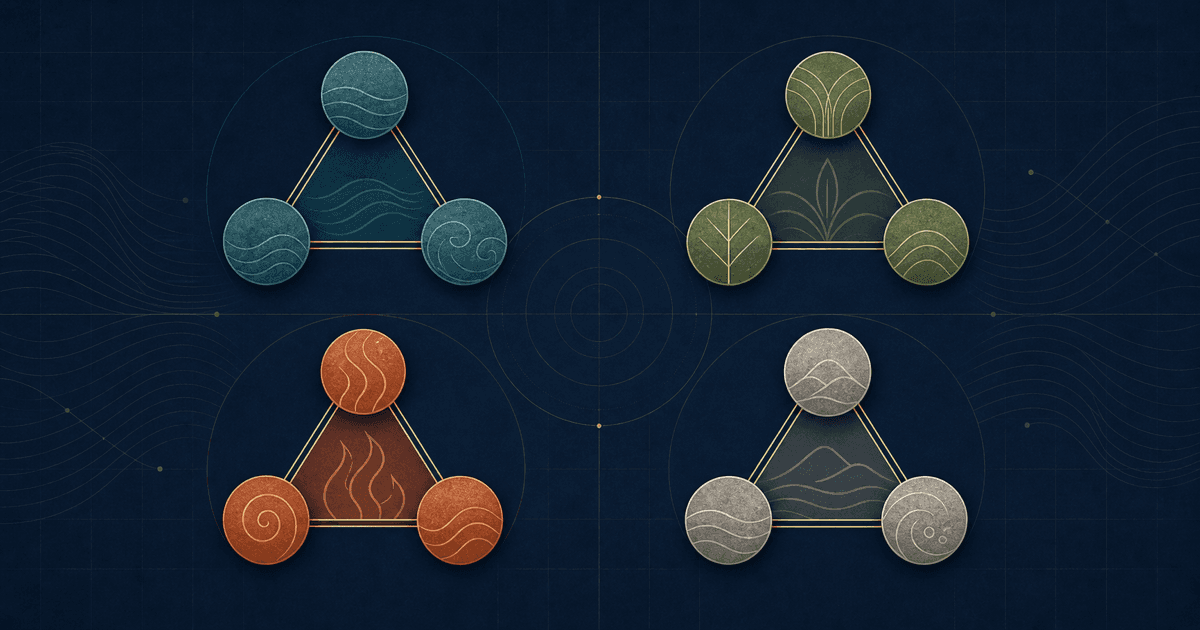
Three Harmony, or San He, is a system of four Earthly Branch groups: Shen-Zi-Chen with Water, Hai-Mao-Wei with Wood, Yin-Wu-Xu with Fire, and Si-You-Chou with Metal. The complete three-branch group is different from a partial pair, and its presence does not automatically prove transformation or predict a harmonious event.
Search terms this guide answers
How to use this guide with DaoReader
- 1List the natal branches using their standard names.
- 2Compare them with the four complete Three Harmony groups.
- 3Mark a two-branch match as partial rather than complete.
- 4Identify whether a luck or annual branch supplies a temporary completion.
- 5Evaluate season, stems, roots, and competing branch relationships.
- 6Use the result as chart context, not as a guaranteed outcome.
The four complete Three Harmony groups
Three Harmony organizes the twelve Earthly Branches into four groups associated with Water, Wood, Fire, and Metal. The groups are Shen-Monkey, Zi-Rat, Chen-Dragon for Water; Hai-Pig, Mao-Rabbit, Wei-Goat for Wood; Yin-Tiger, Wu-Horse, Xu-Dog for Fire; and Si-Snake, You-Rooster, Chou-Ox for Metal. Romanization and animal names may both appear in English tools.
A partial group is not the complete group
When only two members appear, some schools discuss a half-combination or partial Three Harmony relationship. That can be useful terminology if the method is stated, but it should not be written as though all three branches are present. The missing branch and the positions of the visible branches remain material facts.
- Name all branches that are actually present.
- State whether the group is complete or partial.
- Identify natal versus timing-layer branches.
- Do not infer the missing branch from the other two.
Associated element and transformation are not identical
Each Three Harmony group has an associated element, but seeing the group does not settle every transformation question. Readers may examine seasonal support, exposed stems, roots, and disruption by other relationships. Because schools set different thresholds, the method and uncertainty should be disclosed.
Decision point
Still comparing the $29 report?
Use this guide as the buying checklist, then move to the sample report or calculator with clearer expectations.
Why the middle branch is often discussed
Traditional explanations may describe the central or cardinal branch as important to the group's elemental direction. This can help explain the internal logic of the grouping. It should not be turned into a universal rule that ignores season, the rest of the chart, or the difference between a visible relationship and a completed transformation.
Timing can complete a group without guaranteeing an event
A luck pillar or annual branch may supply the third member of a group that is partial in the natal chart. That creates a temporary structural condition under the chosen method. It does not schedule marriage, income, promotion, travel, conflict resolution, health change, or any other concrete event.
Harmony is not a relationship verdict
The English word Harmony can sound like emotional agreement or compatibility. In this context it names a technical grouping. It cannot prove that people get along or that a period will be easy. DaoReader uses Three Harmony for entertainment and self-reflection, never professional or deterministic advice.
The four Three Harmony branch groups
Use the branch names to verify the group before considering its associated element.
| Associated element | Complete branch group | Reading checkpoint |
|---|---|---|
| Water | Shen-Monkey, Zi-Rat, Chen-Dragon | Confirm all three and evaluate transformation conditions |
| Wood | Hai-Pig, Mao-Rabbit, Wei-Goat | Keep a two-branch match labeled partial |
| Fire | Yin-Tiger, Wu-Horse, Xu-Dog | Separate group presence from predicted events |
| Metal | Si-Snake, You-Rooster, Chou-Ox | Review season and competing relationships |
Check whether your chart has a complete or partial group
Calculate the four pillars, map every branch, and keep group detection separate from transformation or outcome claims.
- Verify the branch names and pillar positions.
- Label complete and partial groups accurately.
- Preview the $29 report's responsible reading style.
Before you leave
Ready to move from reading to your own chart?
The useful next step is the chart-first path: calculate the preview, confirm the birth details, then unlock checkout only if the paid report still makes sense.
Common questions
What are the Three Harmony combinations in BaZi?
They are four complete three-branch groups associated with Water, Wood, Fire, and Metal: Shen-Zi-Chen, Hai-Mao-Wei, Yin-Wu-Xu, and Si-You-Chou.
Is a two-branch match a Three Harmony combination?
It is not the complete group. Some methods call it a partial or half-combination, which should be labeled clearly.
Does Three Harmony always transform into an element?
No. Group presence and elemental transformation are separate claims. Transformation criteria vary and may include season, stems, roots, and competing relationships.
Can a luck pillar complete Three Harmony?
A luck or annual branch can temporarily supply a missing member under some methods. It does not guarantee an event or outcome.
Does Three Harmony mean good compatibility?
No. Harmony is the name of a branch grouping, not proof of emotional agreement, relationship quality, marriage, or business compatibility.