BaZi Earthly Branch combination
Earthly Branch Combinations in BaZi: Meaning and Limits
Learn how Earthly Branch combinations are identified in BaZi, why a pair does not automatically transform, and how to avoid outcome predictions.
Report decision
Map the branches before judging a combination
Calculate all four pillars, identify the exact relationship family, and keep transformation criteria separate from the visible pattern.
What you will learn
- Combination is a family of branch relationships, not one single rule.
- A relationship can be present without completing an elemental transformation.
- Two-branch, three-branch, and seasonal groups should be named separately.
- Competing clashes or combinations require the reader to state a method.
- No combination guarantees harmony, marriage, partnership, or success.
What is an Earthly Branch combination in BaZi?
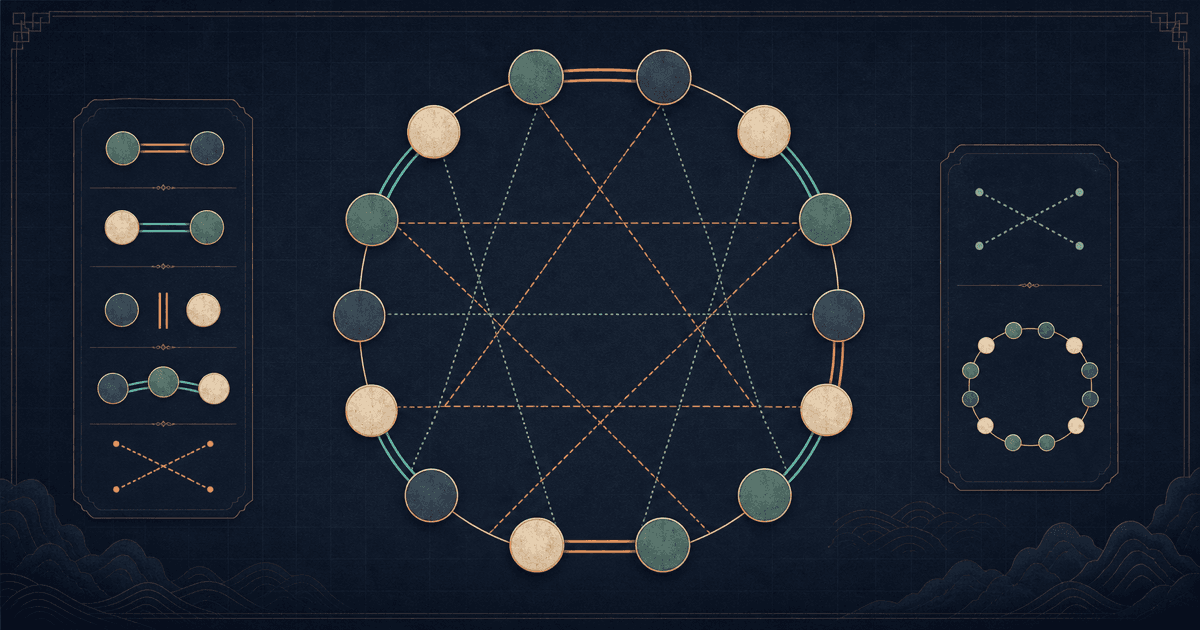
An Earthly Branch combination is a recognized relationship between two or more of the chart's twelve branches. Common families include the Six Combinations, Three Harmony groups, and seasonal directional groups. A visible pair or group does not automatically transform into another element; transformation requires a declared method and supporting conditions.
Search terms this guide answers
How to use this guide with DaoReader
- 1List the four natal Earthly Branches in pillar order.
- 2Name the combination family being checked.
- 3Verify whether the full pair or group is present.
- 4Separate relationship detection from any transformation claim.
- 5Review season, supporting stems, roots, and competing branch relations.
- 6Use the structure as a reflection prompt rather than an event forecast.
Combination is an umbrella term
BaZi references several branch groupings as combinations. The Six Combinations are paired relationships, Three Harmony uses three-branch element groups, and directional or seasonal combinations use another set of three. Some schools also discuss partial groupings. Naming the family is essential because the required branches and interpretive logic differ.
Relationship and transformation are separate claims
Finding the required branches establishes that a named relationship is visible under the chosen method. It does not by itself prove that the branches transform into a resulting element. Transformation discussions may consider season, exposed stems, roots, support, obstruction, and competing relationships. Readers should state those criteria instead of treating an app icon as proof.
- First identify the branch relationship.
- Then declare the transformation criteria.
- Show which supporting conditions are present or absent.
- Keep uncertainty visible when schools differ.
Pillar position frames a question
The branches belong to the year, month, day, and hour pillars, so their positions can frame which parts of the chart are interacting. This does not let a reader identify a guaranteed event or assign blame to a family member, spouse, colleague, or child. Pillar symbolism remains a reflective convention.
Decision point
Still comparing the $29 report?
Use this guide as the buying checklist, then move to the sample report or calculator with clearer expectations.
More than one relationship may be present
A branch can participate in a combination while another visible branch forms a clash, harm, punishment, or different combination. Schools use different rules for priority and transformation. A transparent reading names the competing structures and explains its chosen method rather than hiding ambiguity.
Combination does not equal compatibility
A branch combination may be translated with words such as joining, coordination, or attraction, but it cannot prove that two people are compatible. It also cannot guarantee marriage, loyalty, a business partnership, agreement, or emotional harmony. Real relationships require consent, communication, behavior, and shared circumstances.
A careful use of branch combinations
Use combination patterns to ask how different chart functions might be coordinated or redirected. Compare the idea with lived experience and the full chart. DaoReader provides BaZi for entertainment and self-reflection and does not use branch combinations for medical, legal, financial, mental-health, safety, or deterministic advice.
Common Earthly Branch combination families
These families use different group sizes and should be identified by name.
| Family | Basic structure | Important limit |
|---|---|---|
| Six Combinations | Six recognized branch pairs | A pair does not automatically prove transformation |
| Three Harmony | Four recognized three-branch element groups | A partial group is not the same as the full group |
| Directional combination | Three branches associated with one season or direction | Season and method remain important |
| Timing-layer combination | A luck or annual branch completes a temporary relationship | Does not schedule a partnership or favorable event |
Map the branches before judging a combination
Calculate all four pillars, identify the exact relationship family, and keep transformation criteria separate from the visible pattern.
- Confirm each branch and pillar position.
- Name the combination family and method.
- Use the $29 report as a reflective guide, not a prediction.
Before you leave
Ready to move from reading to your own chart?
The useful next step is the chart-first path: calculate the preview, confirm the birth details, then unlock checkout only if the paid report still makes sense.
Common questions
What are the Six Combinations in BaZi?
They are six recognized pairs among the twelve Earthly Branches. The presence of a pair shows the named relationship under that method, not an automatic elemental transformation.
Does every branch combination transform?
No. Transformation is a separate interpretive claim. A method may require seasonal support, stems, roots, or the absence of competing conditions.
Is a partial Three Harmony group a full combination?
No. Some schools interpret partial groupings, but they should be labeled as partial and not presented as though all three branches were present.
Does a branch combination mean two people are compatible?
No. It cannot prove attraction, compatibility, marriage, loyalty, or relationship quality.
Can an annual branch complete a combination?
It can create a temporary relationship under some methods. That does not guarantee an event, partnership, or outcome during the year.