how to calculate BaZi chart
How to Calculate a BaZi Chart: BaZi Calculator Guide
Learn how to calculate a BaZi chart from birth date, birth time, and birthplace, then read Four Pillars, Day Master, Five Elements, and report context.
Report decision
Ready to calculate your own BaZi chart?
Use DaoReader when you want a chart-first flow: enter birth details, review the Four Pillars context, compare the sample, then decide whether the $29 English report is useful for you.
What you will learn
- A BaZi chart calculation starts with birth date, birth time, and birthplace.
- A Four Pillars calculator should show year, month, day, and hour pillars before checkout.
- The Day Master and Five Elements are chart context, not fixed personality labels.
- Unknown birth time should stay marked as uncertainty instead of guessed precision.
- A paid report should expand the visible chart in plain English and avoid guaranteed outcomes.
How do you calculate a BaZi chart?
To calculate a BaZi chart, enter birth date, birth time, and birthplace, then convert that moment into the year, month, day, and hour pillars. A responsible calculator should show Heavenly Stems, Earthly Branches, Day Master, Five Elements, and unknown-time limits before any paid interpretation.
Search terms this guide answers
How to use this guide with DaoReader
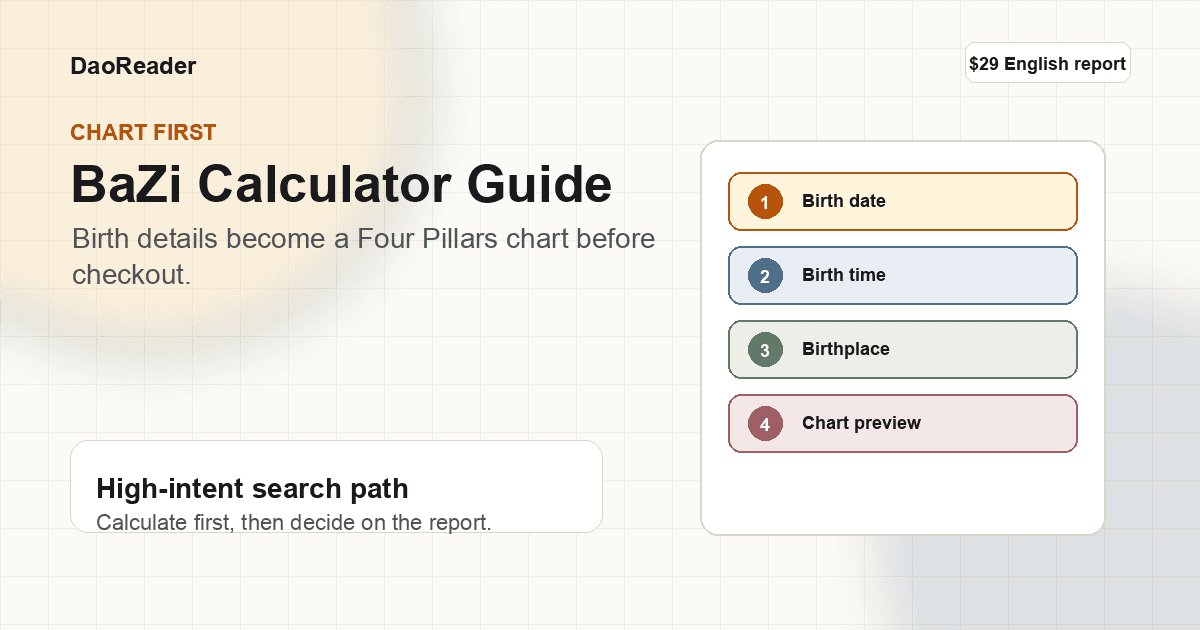
- 1Enter birth date from a reliable record.
- 2Add birth time if known, or mark it unknown instead of guessing.
- 3Use birthplace so local time-zone context can be resolved.
- 4Review year, month, day, and hour pillars before reading interpretation.
- 5Check Day Master, Five Elements, and timing labels as chart context.
- 6Compare the sample report and calculator-vs-report guide before paying.
How to calculate a BaZi chart
A BaZi chart is calculated by turning a birth moment into four pillars: year, month, day, and hour. The useful path is simple: enter birth date, add birth time if known, include birthplace for local time context, then check the calculated chart before reading any interpretation.
- Birth date anchors the year, month, and day pillars.
- Birth time creates the hour pillar when the time is known.
- Birthplace helps resolve local time-zone context before calculation.
What is a Four Pillars calculator?
A Four Pillars calculator is another name for a BaZi calculator. It builds the year, month, day, and hour pillars from birth details, then uses those pillars as the chart foundation for Day Master, element balance, hidden stems, and timing themes.
- Four Pillars means year pillar, month pillar, day pillar, and hour pillar.
- Eight Characters means each pillar's Heavenly Stem and Earthly Branch.
- The Day Master comes from the day pillar and becomes the main chart reference.
Birth date, birth time, and birthplace each change the result
Searchers often treat a BaZi calculator like a simple birthday lookup, but Four Pillars calculation is more specific. The date anchors the year, month, and day pillars. The birth time determines the hour pillar. The birthplace helps resolve local time and time-zone context before the chart is interpreted.
- Birth date is needed for the year, month, and day pillars.
- Birth time determines the hour pillar and can change hidden-stem emphasis.
- Birthplace helps avoid time-zone mistakes when the birth location differs from the reader's current location.
What to look for in a Four Pillars chart preview
The chart is not just a list of symbols. A useful BaZi chart preview should make the year, month, day, and hour pillars visible, then connect those pillars to the Day Master, seasonal strength, visible elements, hidden stems, and timing layers. A good English explanation names the pattern without turning it into a guarantee.
- Four Pillars: the year, month, day, and hour structure.
- Eight Characters: each pillar's Heavenly Stem and Earthly Branch.
- Day Master: the day stem used as the main reference point.
- Five Elements: Wood, Fire, Earth, Metal, and Water relationships in the chart.
Decision point
Still comparing the $29 report?
Use this guide as the buying checklist, then move to the sample report or calculator with clearer expectations.
Calculator result vs report interpretation
A calculator answers the calculation question. A paid English report should answer the interpretation question: what the visible chart suggests as reflection themes, where the input is uncertain, and which life decisions stay outside the report's scope.
- The free chart step helps you confirm the calculation before paying.
- The $29 report expands the chart into plain-English themes and prompts.
- The report keeps medical, legal, financial, mental health, and safety decisions outside its scope.
Why Day Master and Five Elements searches belong on the calculator page
Many people search for a Day Master calculator or a Five Elements BaZi calculator after they already have a birth chart. Those terms should not be separated from the chart flow. The Day Master only makes sense in relation to the month, surrounding stems, branches, hidden stems, and element balance.
- A Day Master label is a starting point, not a complete personality reading.
- Element balance should be read with season and support, not by counting symbols alone.
- Useful-element language should be cautious because it depends on the whole chart.
When a calculator result should make you cautious
A BaZi calculator result should be treated carefully when the birth time is unknown, the birth location is uncertain, the person was born near a time-zone or date boundary, or the page promises exact outcomes. A responsible tool should mark uncertainty and avoid high-confidence predictions from incomplete data.
BaZi calculation checklist
Use this checklist after any BaZi birth chart calculator result. It helps separate calculation quality from interpretation quality before you decide whether a paid report is useful.
| Step | Calculator should show | Check before interpretation |
|---|---|---|
| Birth data | Birth date, birth time, birthplace, and time-known status | Unknown birth time is marked clearly |
| Four Pillars | Year, month, day, and hour pillars | Pillars are visible before checkout |
| Eight Characters | Heavenly Stems and Earthly Branches | Symbols are connected to plain-English meaning |
| Day Master | Day stem as chart anchor | Not treated as a complete personality label |
| Five Elements | Wood, Fire, Earth, Metal, and Water context | Element claims include season and chart context |
| Report decision | Free preview before payment | Sample report, price, and responsible-use limits are easy to inspect |
Ready to calculate your own BaZi chart?
Use DaoReader when you want a chart-first flow: enter birth details, review the Four Pillars context, compare the sample, then decide whether the $29 English report is useful for you.
- No payment before the chart preview.
- Plain-English report sections after checkout.
- Entertainment and self-reflection framing, not professional advice.
Before you leave
Ready to move from reading to your own chart?
The useful next step is the chart-first path: calculate the preview, confirm the birth details, then unlock checkout only if the paid report still makes sense.
Common questions
How do you calculate a BaZi chart?
Enter birth date, birth time, and birthplace, then convert that birth moment into year, month, day, and hour pillars. The chart should show Heavenly Stems, Earthly Branches, Day Master, Five Elements, and any birth-time uncertainty before interpretation.
What is a Four Pillars calculator?
A Four Pillars calculator is another name for a BaZi calculator. It creates the year, month, day, and hour pillars from birth details and uses those pillars as the basis for chart interpretation.
Is a BaZi calculator enough by itself?
It can identify the chart, but interpretation still needs context. A calculator shows the symbols; a responsible report explains how the symbols relate.
Should I pay before seeing my chart?
DaoReader does not ask for payment before the chart step. You enter birth details, review the chart context, then decide whether to order the $29 report.
What if I do not know my birth time?
You can still review part of the chart, but the hour pillar should be treated as unknown or uncertain. DaoReader should not invent hour-pillar detail from a guessed time.
Is DaoReader a free BaZi calculator?
The chart preview is available before checkout. The full English report is a one-time $29 purchase if you want a longer interpretation.
Should I compare the sample report before paying?
Yes. The sample report shows the structure, tone, chart evidence, and responsible-use boundaries, so it is the best way to decide whether the paid report adds value beyond the calculator preview.