BaZi report example
BaZi Report Example: What an English Reading Should Include
See what a responsible BaZi report example should include: chart context, Day Master, Five Elements, timing themes, relationship patterns, and clear limits.
Report decision
See your own chart before ordering
DaoReader is built for buyers who want transparency: calculate the Four Pillars chart first, then decide whether the $29 English report is worth ordering.
What you will learn
- A report example should make the structure and tone visible before purchase.
- Good reports explain chart evidence rather than hiding behind terminology.
- The sample should show how Day Master, Five Elements, timing, relationship, and work themes connect.
- Responsible reports avoid medical, financial, legal, mental health, safety, and guaranteed-outcome claims.
What should a BaZi report example show?
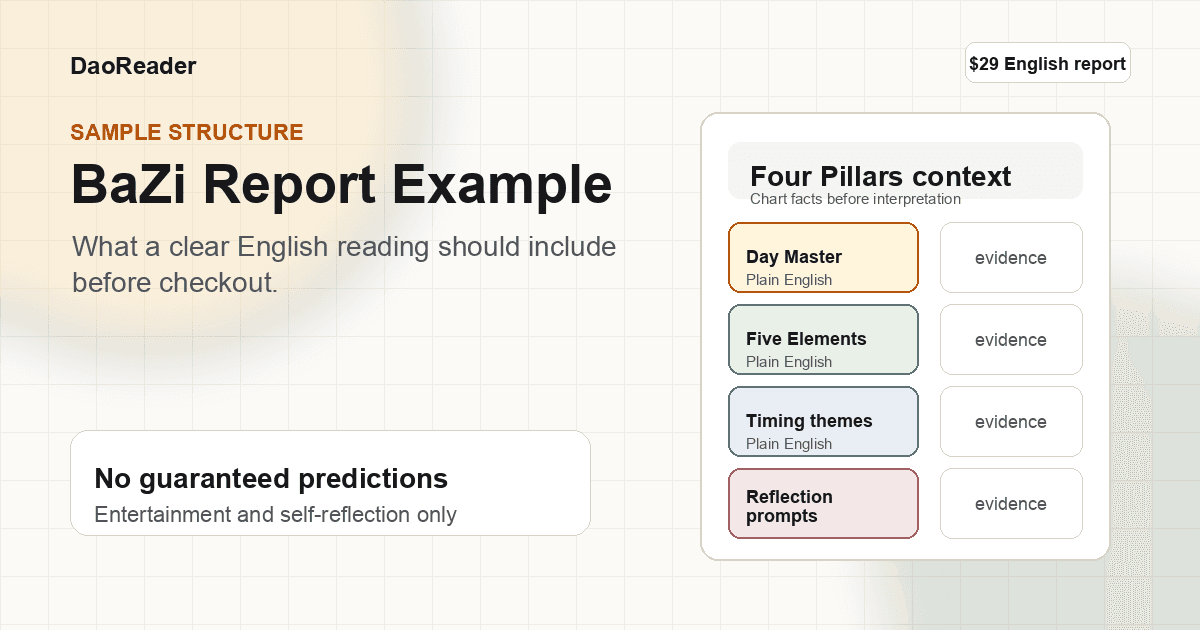
A useful BaZi report example should show the chart context, Day Master, Five Elements balance, chart patterns, timing themes, practical reflection prompts, and responsible-use limits. It should explain how conclusions are connected to the chart instead of offering vague or guaranteed predictions.
Search terms this guide answers
How to use this guide with DaoReader
- 1Check whether the report starts from the calculated Four Pillars chart.
- 2Look for plain-English explanations of Day Master and Five Elements.
- 3Review whether timing themes are framed as reflection rather than certainty.
- 4Compare the report tone with the responsible-use disclaimer.
- 5Use the sample to decide whether the full report format fits your needs.
Chart context before interpretation
A BaZi report should not begin with broad personality statements. It should first show the birth details, time zone context, Four Pillars, Day Master, and element balance that support the interpretation.
- The reader should know which birth details shaped the chart.
- The report should name the chart facts behind each major theme.
- The chart preview should appear before checkout whenever possible.
Plain-English sections that reduce confusion
A strong English report should translate traditional terms into usable language. DaoReader organizes reports around Day Master context, Five Elements balance, chart pattern, work style, money habits, relationship patterns, timing themes, and reflection prompts.
- Day Master context explains the chart's reference point.
- Five Elements balance explains visible and hidden support or pressure.
- Work, money, and relationship sections translate chart themes into reflective language.
- Timing sections describe symbolic periods without promising exact outcomes.
What a sample report should reveal before payment
A BaZi report sample should not give away a generic horoscope and call it a reading. It should reveal the shape of the paid product: how detailed the sections are, how cautious the claims are, and whether the writer connects interpretations back to the Four Pillars chart.
- Look for chart evidence near each major interpretation.
- Look for plain-English explanations of traditional terms.
- Look for clear limits around professional advice and deterministic prediction.
Decision point
Still comparing the $29 report?
Use this guide as the buying checklist, then move to the sample report or calculator with clearer expectations.
Why examples matter for English BaZi buyers
Many English searchers are not fluent in traditional Chinese metaphysical vocabulary. A report example helps them decide whether the translation style, structure, and responsible-use boundary match what they expect before they pay for a personalized reading.
Responsible limits in a report example
If a sample report promises exact outcomes, guaranteed wealth, fixed relationship results, or health conclusions, that is a warning sign. A better example shows how the report can support reflection while leaving real-world decisions to the reader and qualified professionals.
What to compare before buying a BaZi report
Use this table when evaluating any BaZi report example, especially when the page asks for payment before showing the chart context.
| Check | Stronger report | Weak report |
|---|---|---|
| Chart evidence | Explains which chart facts support each theme | Uses broad statements with no chart reference |
| Language | Plain English with terms translated | Dense jargon or vague horoscope language |
| Timing | Frames timing as reflection prompts | Promises exact events or fixed outcomes |
| Boundaries | Clear entertainment and self-reflection limits | Medical, financial, legal, or certainty claims |
| Purchase flow | Chart preview before payment | Payment before meaningful context |
See your own chart before ordering
DaoReader is built for buyers who want transparency: calculate the Four Pillars chart first, then decide whether the $29 English report is worth ordering.
- Chart context appears before checkout.
- The report expands the chart into structured English sections.
- Responsible-use boundaries stay visible throughout the flow.
Before you leave
Ready to move from reading to your own chart?
The useful next step is the chart-first path: calculate the preview, confirm the birth details, then unlock checkout only if the paid report still makes sense.
Common questions
Should I read a sample before buying a BaZi report?
Yes. A sample helps you evaluate the structure, tone, boundaries, and level of detail before paying for a full report.
Can a BaZi report example predict my future?
No. DaoReader frames BaZi reports as entertainment and self-reflection, not deterministic prediction.
What should an English BaZi report include?
It should include chart context, Day Master, Five Elements, chart pattern, timing themes, relationship or work-style reflections, practical prompts, and clear responsible-use limits.
How is a report different from a BaZi calculator?
A calculator identifies the chart. A report explains what the chart themes may mean in plain English, while keeping the interpretation reflective rather than deterministic.