indirect resource bazi meaning
Indirect Resource in BaZi: Meaning and Chart Context
Learn what Indirect Resource means in BaZi, how it is derived from the Day Master, how it differs from Direct Resource, and why one label never explains a whole chart.
Report decision
See the Day Master before reading a Resource label
Use the calculator to check the Four Pillars and Day Master first. Then compare the sample report before deciding whether the $29 English report's chart-first, reflective approach is useful.
What you will learn
- Indirect Resource is calculated relative to the Day Master, not from a zodiac animal or a simple element count.
- It uses the element that produces the Day Master and the opposite yin-yang polarity from Direct Resource.
- The label can appear in a visible Heavenly Stem or as a hidden stem inside an Earthly Branch.
- Direct Resource and Indirect Resource are related Ten Gods categories, but neither is automatically good, bad, strong, weak, or decisive.
- Season, roots, placement, combinations, clashes, and the rest of the chart change how a traditional reader discusses the relationship.
- Use BaZi for entertainment and self-reflection; keep education, health, career, financial, legal, and safety decisions grounded in real evidence and qualified support.
What does Indirect Resource mean in BaZi?
Indirect Resource is one of the Ten Gods relationships in BaZi. It describes the element that produces the Day Master when its yin-yang polarity differs from the Day Master's polarity. Some traditions call it Pian Yin. It is a symbolic chart relationship, not a diagnosis, a fixed personality trait, an education prediction, or a guarantee about what will happen.
Search terms this guide answers
How to use this guide with DaoReader
- 1Start with the Day Master's Heavenly Stem rather than a personality label or a birth-year animal.
- 2Use the Five Elements generating cycle to identify which element produces that Day Master.
- 3Compare yin-yang polarity to distinguish Direct Resource from Indirect Resource.
- 4Check whether the relationship is visible in a stem, hidden in a branch, repeated, seasonal, or supported elsewhere in the chart.
- 5Read the relationship with the other Ten Gods and chart structure before assigning any theme.
- 6Turn the result into a low-stakes reflection question, then use real information for decisions with consequences.
Indirect Resource is a Ten Gods relationship, not a verdict
In BaZi, Indirect Resource is a relationship label used in the Ten Gods system. It is sometimes translated from Pian Yin, and translation choices vary across schools and websites. The important point is that it is not a standalone personality test. The label only has meaning relative to the Day Master, the element cycle, yin-yang polarity, placement, and the rest of the chart. A chart can show the relationship without proving that someone learns, behaves, succeeds, struggles, or should make a particular choice in one fixed way.
- Do not confuse Indirect Resource with a literal school subject, qualification, or source of income.
- Do not read one Ten Gods label before locating the Day Master and seasonal context.
- Treat different English translations as vocabulary differences until the method is made clear.
How the Day Master creates the Resource relationship
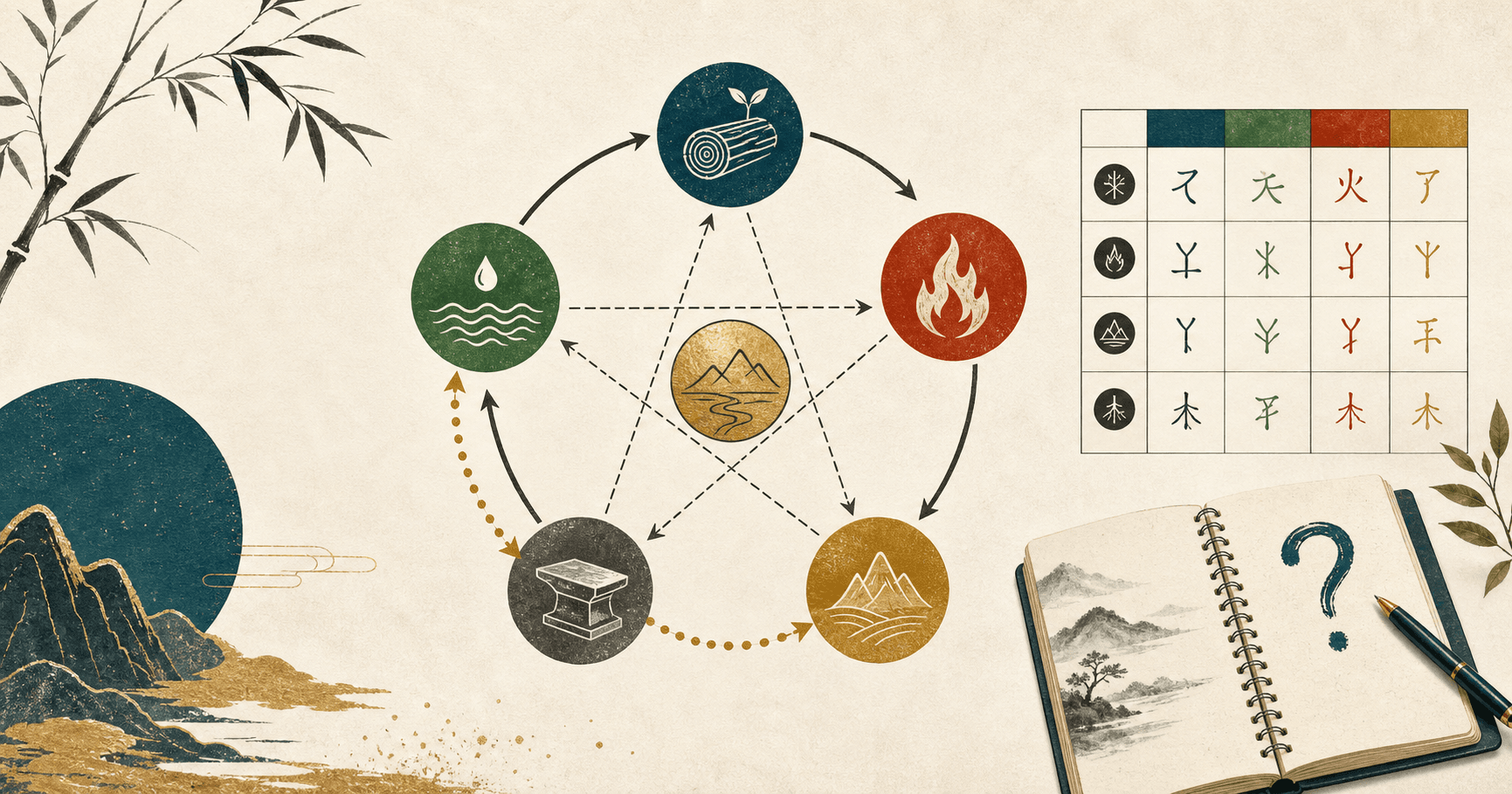
The Day Master is the Heavenly Stem of the day pillar and is the reference point for Ten Gods relationships. The Five Elements generating cycle runs Wood to Fire, Fire to Earth, Earth to Metal, Metal to Water, and Water to Wood. The element that produces the Day Master belongs to the Resource family. Yin-yang polarity then separates that family into Direct Resource and Indirect Resource. This is why a chart cannot identify Indirect Resource by looking only at which element appears most often.
- For a Fire Day Master, Wood is the Resource element because Wood produces Fire.
- For an Earth Day Master, Fire is the Resource element because Fire produces Earth.
- Polarity is part of the distinction, so the same generating element can produce Direct Resource or Indirect Resource depending on the stem relationship.
Where to find Indirect Resource in a chart
A Ten Gods relationship may be visible in a Heavenly Stem, hidden inside an Earthly Branch, or repeated across several places. Visibility alone does not settle importance. A visible stem can be easy to notice, while a hidden stem may need branch and seasonal context to understand. Traditional reading methods also look at whether an element has roots, whether it is supported or controlled, its pillar placement, and the other relationships around it. A calculator can make chart facts visible, but it cannot turn one symbol into a complete life explanation.
- Check the Day Master's element and polarity first.
- Review the visible stems, then inspect hidden stems in the branches.
- Keep season, combinations, clashes, and chart structure in view before describing a theme.
Indirect Resource and Direct Resource are not a good-bad pair
A common mistake is to treat Direct Resource as positive and Indirect Resource as negative, or the reverse. That reduces a relationship system to a scorecard. In traditional discussion, writers may associate Resource language with support, input, study, preparation, care, reference material, or ways of receiving and processing ideas. Those associations are starting points for interpretation, not universal facts. The same label can be discussed differently when it is balanced, excessive, absent, useful in a stated method, or in tension with other chart relationships.
- A label does not rank a person, learning style, relationship, or future outcome.
- A single association should not become a medical, mental-health, educational, or career conclusion.
- Ask which method a reader is using before accepting a positive or negative claim.
Decision point
Still comparing the $29 report?
Use this guide as the buying checklist, then move to the sample report or calculator with clearer expectations.
Why full-chart context changes the conversation
BaZi does not read a Resource relationship in isolation. The month branch sets seasonal context, while visible and hidden stems show different layers of the chart. Other Ten Gods, combinations, clashes, repeated pillars, and timing layers can change what a reader notices. Different schools may weight those ingredients differently. A responsible explanation should state the chart facts being discussed and leave uncertainty visible, rather than claiming that Indirect Resource proves an event, a talent, an academic result, or a personal problem.
- A strong-looking element is not automatically helpful, harmful, or decisive.
- A hidden relationship is not automatically absent or unimportant.
- Timing language adds another layer; it does not turn a symbolic label into a deadline or forecast.
Use the label for a reflection question, not a prescription
A practical way to use an Indirect Resource explanation is to ask open questions. For example: Do I prefer to gather context before acting? Which kinds of mentors, reference materials, quiet time, or learning environments actually help me? When do I rely on preparation, and when do I need to test an idea in the real world? Those questions can be compared with lived experience. They should not replace assessment, study planning, therapy, medical care, financial planning, career research, contracts, or advice from qualified professionals.
- Keep the question testable against your real experience.
- Let evidence, feedback, and personal circumstances outweigh any chart label.
- Do not make choices for another person from their chart without their consent or real-world information.
What DaoReader adds after the free chart
DaoReader starts with the birth details and visible Four Pillars so you can see the chart context before checkout. The one-time $29 English report explains relationships in plain language and keeps entertainment and self-reflection limits explicit. It does not diagnose a condition, evaluate intelligence, predict grades, choose a career, promise wealth, or tell you what will happen. Review the sample report first, then decide whether that bounded format is useful for you.
Resource terms in context
These labels share a place in the Ten Gods system, but neither is a standalone answer about a person or outcome.
| Term | What the label describes | What it cannot establish |
|---|---|---|
| Resource family | The element that produces the Day Master in the Five Elements cycle | A fixed learning ability, support system, or future result |
| Direct Resource | A Resource relationship with one yin-yang polarity relative to the Day Master | That a person is automatically conventional, protected, educated, or successful |
| Indirect Resource | A Resource relationship with the other yin-yang polarity relative to the Day Master | A diagnosis, unusual talent claim, problem, or guaranteed life event |
| Visible or hidden placement | Where the relationship appears in stems or branches of a calculated chart | Its final importance without season, roots, other relationships, and method context |
See the Day Master before reading a Resource label
Use the calculator to check the Four Pillars and Day Master first. Then compare the sample report before deciding whether the $29 English report's chart-first, reflective approach is useful.
- Confirm the birth date, time, and birthplace used for the chart.
- Keep the Resource relationship connected to visible chart facts.
- Review the report format and responsible-use boundary before paying.
Before you leave
Ready to move from reading to your own chart?
The useful next step is the chart-first path: calculate the preview, confirm the birth details, then unlock checkout only if the paid report still makes sense.
Common questions
What is Indirect Resource in BaZi?
Indirect Resource is a Ten Gods relationship. It uses the element that produces the Day Master and the yin-yang polarity opposite to Direct Resource. It is a symbolic chart label, not a prediction or diagnosis.
Is Indirect Resource the same as Pian Yin?
Many English-language BaZi sources use Indirect Resource for Pian Yin, but translations and teaching conventions vary. Check how a reader defines the term and keep it tied to the Day Master and element relationship.
How do I find Indirect Resource in my BaZi chart?
Start with the Day Master's Heavenly Stem, identify the element that produces it in the Five Elements cycle, then use yin-yang polarity to separate Direct Resource from Indirect Resource. Check both visible stems and hidden stems with whole-chart context.
Is Indirect Resource good or bad in BaZi?
Neither. A Ten Gods label is not a good-bad score. Traditional interpretation depends on chart context, method, season, placement, and other relationships, and it still should not become a verdict about a person or future outcome.
Can Indirect Resource predict education or intelligence?
No. A BaZi chart cannot assess intelligence, diagnose a learning issue, predict grades, select a course, or replace educational assessment and support. Use the label only for low-stakes reflection.
Can DaoReader tell me what Indirect Resource means for my future?
DaoReader explains chart relationships for entertainment and self-reflection. The $29 report does not promise a future event, academic outcome, job result, health conclusion, financial result, legal answer, or safety decision.