how many elements in BaZi
How Many Elements Are in BaZi? Five Elements Explained
BaZi uses five elements: Wood, Fire, Earth, Metal, and Water. Learn where they appear in the Four Pillars and why counts alone do not show balance.
Report decision
See the five elements in your own Four Pillars
Calculate your chart, locate the Day Master, and inspect the visible and hidden element evidence. Then preview the report structure before deciding whether DaoReader's one-time $29 English interpretation is useful.
What you will learn
- The five BaZi elements are Wood, Fire, Earth, Metal, and Water.
- The ten Heavenly Stems are yin and yang expressions of those five categories, not ten separate elements.
- A Four Pillars chart contains eight visible characters, and the branches can also contain hidden stems.
- An element count is an inventory, not a reliable measure of strength, balance, usefulness, or luck.
- A missing visible element may still appear in hidden stems and does not automatically need a remedy.
- Use element language for entertainment and self-reflection, not guaranteed outcomes or professional advice.
How many elements are in BaZi?
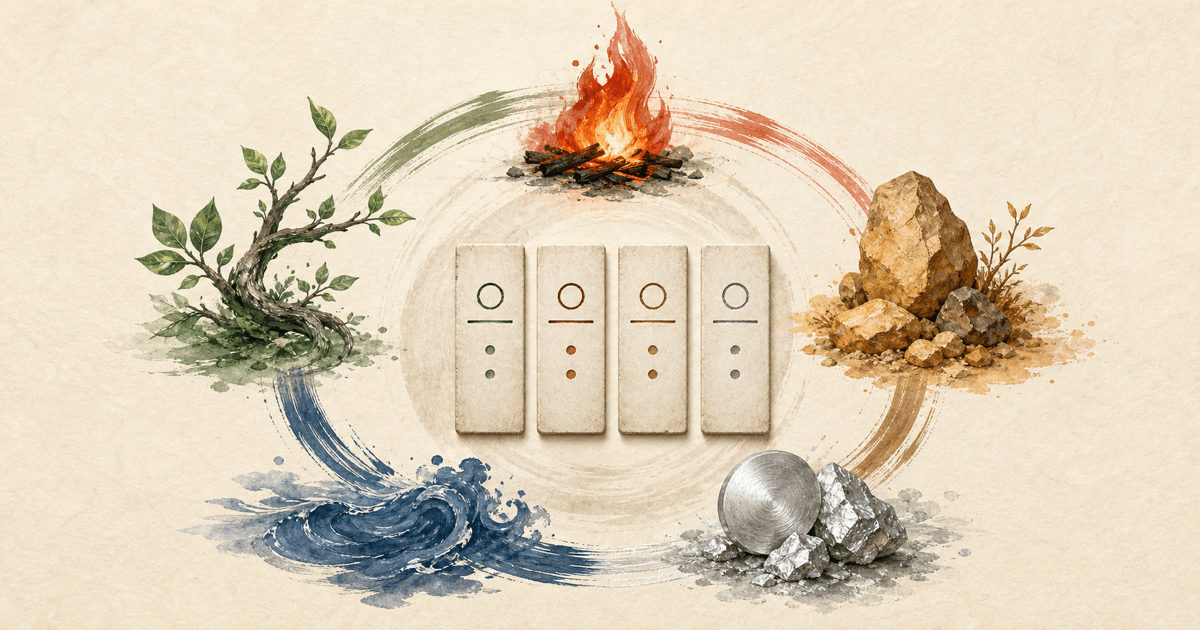
BaZi uses five elements: Wood, Fire, Earth, Metal, and Water. They are the Five Phases, or Wu Xing, used to classify the chart's Heavenly Stems and Earthly Branches. A chart has more than five positions and may repeat the same element, so the answer is five element categories—not five total symbols. Season, position, hidden stems, and relationships matter more than a raw count.
Search terms this guide answers
How to use this guide with DaoReader
- 1Calculate the year, month, day, and hour pillars from recorded birth details.
- 2Identify the element of each visible Heavenly Stem.
- 3Identify the primary element associated with each Earthly Branch.
- 4Open the hidden-stem details instead of relying only on the eight visible characters.
- 5Note the month branch and season before comparing support, expression, control, and drain.
- 6Treat counts as a map of what appears, not a score of what is good, bad, missing, or required.
The direct answer: BaZi has five elements
The five elements in BaZi are Wood, Fire, Earth, Metal, and Water. The traditional Chinese term Wu Xing is often translated as Five Elements, although Five Phases better conveys that these are patterns of change and relationship rather than five physical substances. BaZi uses the categories to organize the Heavenly Stems, Earthly Branches, seasons, and the relationships read around the Day Master.
- Wood: growth, extension, and movement.
- Fire: warmth, visibility, and transformation.
- Earth: stability, containment, and transition.
- Metal: structure, refinement, and separation.
- Water: flow, storage, and adaptation.
Why some charts seem to show ten elements
BaZi has ten Heavenly Stems because each of the five elements has a yang and a yin expression. Jia and Yi are Wood; Bing and Ding are Fire; Wu and Ji are Earth; Geng and Xin are Metal; Ren and Gui are Water. Those are ten stem types, not ten elements. The yin-yang distinction adds detail without changing the number of element categories.
- Five elements multiplied by two yin-yang expressions equals ten Heavenly Stems.
- The Heavenly Stem of the day pillar is the Day Master.
- The Day Master element is a reference point, not the only element that matters.
Where the five elements appear in the Four Pillars
A BaZi chart has four pillars—year, month, day, and hour—and each pillar has one Heavenly Stem above one Earthly Branch. That produces the Eight Characters visible in the chart. Every stem belongs to one element. Each branch also has an elemental association and can contain one or more hidden stems, so the full element picture extends beyond the eight symbols displayed on the surface.
- Four visible stems each carry an element and yin-yang quality.
- Four visible branches carry seasonal and elemental context.
- Hidden stems inside the branches can add elements that a simple surface count misses.
- If birth time is unknown, the hour pillar and its element evidence remain uncertain.
Five categories do not mean five equal shares
A real chart does not need one equal portion of every element. An element can repeat across stems and branches, appear only in hidden stems, or be absent from the positions a calculator counts. BaZi interpretation therefore asks how elements function in context rather than whether a chart forms a perfectly even five-part chart.
Why raw element counts can mislead
A bar chart can be useful for locating repeated or absent symbols, but it cannot settle strength or balance by itself. The month branch and season influence which qualities are timely. Roots, hidden stems, combinations, clashes, and the position of a symbol also affect how it is read. Two charts with the same visible element totals can therefore have different structures and different interpretive questions.
- Count answers which symbols a tool included.
- Season helps show which qualities have contextual support.
- Position and relationships show how an element connects to the Day Master.
- A useful interpretation should explain its reasoning instead of presenting a percentage as a verdict.
Decision point
Still comparing the $29 report?
Use this guide as the buying checklist, then move to the sample report or calculator with clearer expectations.
What a missing element does—and does not—mean
Missing usually means an element did not appear in the positions included by a particular tool. It may still exist in hidden stems, and visible absence does not prove deficiency, bad luck, weakness, or a need to add that element. Do not prescribe colors, objects, diets, careers, investments, partners, or other remedies from a missing-element count. Review the full chart and the method behind the label first.
A practical reading order for the Five Elements
Start with accurate birth details and verify the Four Pillars. Locate the Day Master, then note the month season, visible stems, branches, and hidden stems. Only after that should you compare which elements support, are produced by, control, or are controlled by the Day Master. This order keeps the element discussion tied to chart evidence instead of turning it into a five-color personality quiz.
What the calculator and report each add
DaoReader's calculator shows the chart context before checkout, including the pillars needed to identify the Day Master and element distribution. The optional one-time $29 English report adds a bounded explanation of how the visible chart relationships may support reflection. It does not convert an element count into guaranteed personality, compatibility, career, wealth, health, safety, or future-event claims.
Use the five elements as reflection, not certainty
Element language can give readers a compact way to notice patterns such as support, expression, pressure, structure, or adaptability. Those themes are most useful when compared with lived experience and revised when they do not fit. DaoReader presents BaZi as entertainment and self-reflection; it does not replace medical, legal, financial, mental-health, safety, or other professional advice.
Five elements, ten stems, and eight characters
These numbers describe different layers of the same BaZi chart and should not be treated as competing answers.
| Number | What it describes | Common mistake |
|---|---|---|
| 5 | Wood, Fire, Earth, Metal, and Water element categories | Assuming each must occupy an equal share |
| 10 | Five elements expressed through yin and yang Heavenly Stems | Calling them ten separate elements |
| 8 | One visible stem and branch in each of the Four Pillars | Ignoring the hidden stems inside branches |
| Variable | How often element symbols appear in a particular chart | Treating frequency as strength, usefulness, or luck |
See the five elements in your own Four Pillars
Calculate your chart, locate the Day Master, and inspect the visible and hidden element evidence. Then preview the report structure before deciding whether DaoReader's one-time $29 English interpretation is useful.
- Review the four pillars before interpreting element totals.
- Keep unknown birth time visible as uncertainty.
- Compare the sample report's tone and responsible-use limits before checkout.
Before you leave
Ready to move from reading to your own chart?
The useful next step is the chart-first path: calculate the preview, confirm the birth details, then unlock checkout only if the paid report still makes sense.
Common questions
How many elements are there in BaZi?
There are five: Wood, Fire, Earth, Metal, and Water. They are categories used throughout the Four Pillars chart, not five total objects that appear once each.
Why are there ten Heavenly Stems if BaZi has five elements?
Each element has a yang and a yin Heavenly Stem, creating ten stems in total. The stems add yin-yang detail but still belong to the same five element categories.
Does every BaZi chart contain all five elements?
Not necessarily in the visible eight characters. An element can repeat, appear only in hidden stems, or be absent from the positions a tool shows. That pattern should be read with season, roots, position, and relationships.
Is the strongest element simply the one with the highest count?
No. Counts show frequency under a tool's method. Strength and function also depend on season, roots, hidden stems, position, combinations, and relationships to the Day Master.
Does a missing element mean my chart is unbalanced?
No. Visible absence does not automatically mean weak, harmful, needed, or favorable. A missing element may appear in hidden stems, and a full-chart method is required before making any interpretive claim.
Can the Five Elements predict my personality or future?
No. They can provide symbolic language for entertainment and self-reflection, but they cannot guarantee identity, compatibility, career, wealth, health, safety, events, or professional outcomes.
Can I read the elements if my birth time is unknown?
You can review the pillars that can be calculated reliably, but the hour pillar and its visible and hidden element evidence remain unknown. Keep that limitation explicit instead of guessing a time.