how does BaZi work
How Does BaZi Work? A Clear Guide to the Four Pillars
Learn how BaZi works from birth details to the Four Pillars, Day Master, Five Elements, hidden stems, timing cycles, and a responsible English interpretation.
Report decision
See the method before you order a report
Start with the free Four Pillars calculator, then inspect the sample report. The $29 checkout only needs to matter after your chart and the report scope are clear.
What you will learn
- BaZi starts with birth date, birth time, and birthplace, not only a zodiac animal.
- The Four Pillars contain eight characters: one Heavenly Stem and one Earthly Branch for each pillar.
- The Day Master is the reference point, while the birth month provides crucial seasonal context.
- Five Element balance cannot be judged by simply counting visible symbols.
- Hidden stems and symbolic relationships add context after the basic chart is established.
- Luck Pillars and annual pillars describe timing themes, not guaranteed events.
- A responsible BaZi reading supports entertainment and self-reflection rather than professional advice.
How does BaZi work?
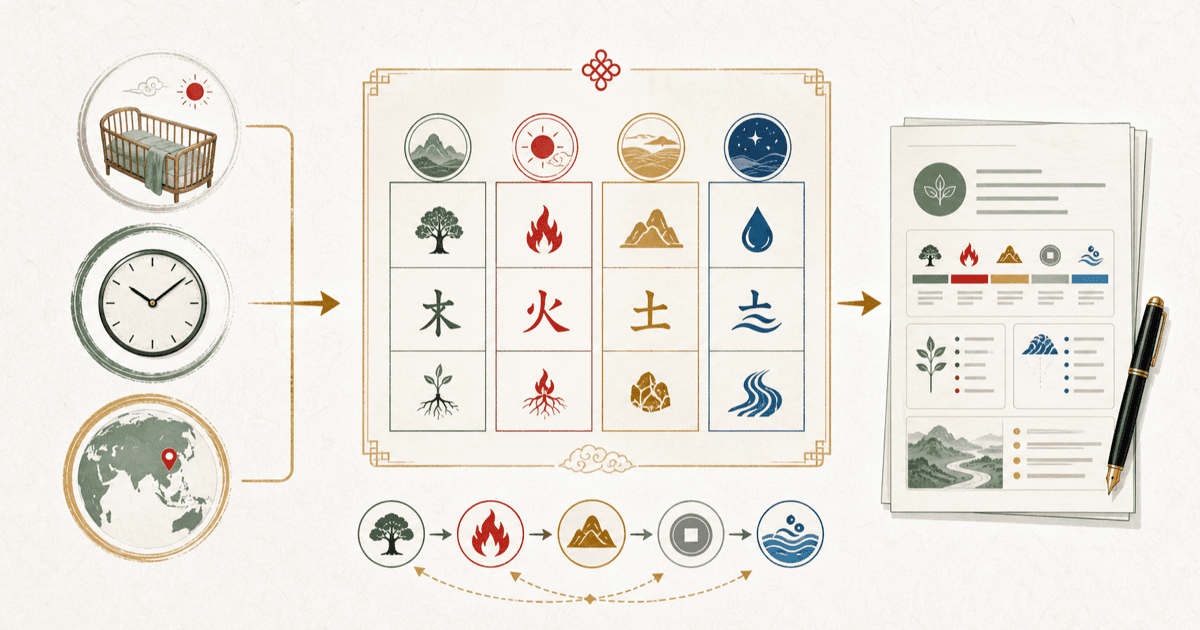
BaZi works by converting a person's birth year, month, day, and hour into four pairs of Chinese calendar symbols called the Four Pillars. A reading uses the Day Master, season, Five Elements, hidden stems, symbolic relationships, and timing cycles to organize reflective themes. It is a traditional interpretive system, not a scientific predictor or guaranteed forecast.
Search terms this guide answers
How to use this guide with DaoReader
- 1Collect the birth date, local birth time, and birthplace, marking an unknown time honestly.
- 2Convert the birth moment into year, month, day, and hour stem-branch pairs.
- 3Identify the Day Master and read it in the season set by the month branch.
- 4Review visible elements, hidden stems, combinations, clashes, and repeated patterns.
- 5Translate chart relationships into cautious themes instead of fixed personality labels.
- 6Add 10-year Luck Pillars and annual context only after the natal chart is understood.
- 7Compare the interpretation with lived experience and keep high-stakes decisions outside the chart.
From birth details to the Eight Characters
BaZi, commonly translated as Eight Characters, begins with a specific birth moment. The calculation places that moment inside the traditional Chinese solar calendar and produces four pillars for the year, month, day, and hour. Each pillar contains a Heavenly Stem above an Earthly Branch, creating eight visible characters in total. Birthplace matters because local time and time-zone handling can change the hour pillar and, near a boundary, sometimes the calendar day used by the calculator.
- Year pillar: broad generational and early-environment context.
- Month pillar: season and an important reference for chart strength.
- Day pillar: the Day Master plus the day branch, often called the spouse palace.
- Hour pillar: later-life, private, project, or legacy themes, with caution when birth time is unknown.
Why BaZi is more than a Chinese zodiac sign
A Chinese zodiac sign usually refers to the animal associated with the birth year. BaZi uses that year branch but does not stop there. Two people born in the same zodiac year can have different month, day, and hour pillars, different seasonal conditions, and different relationships among the elements. That is why a Four Pillars chart contains more individualized structure than a year-animal horoscope, even though both belong to Chinese metaphysical traditions.
- The zodiac animal is one branch in one pillar, not the full chart.
- The day stem, called the Day Master, becomes the reading reference point.
- Season and hidden stems can change how visible symbols are interpreted.
The Day Master and seasonal context
The Day Master is the Heavenly Stem of the day pillar. Readers use it as a reference for describing how other chart symbols relate to the person, but it should not be treated as a complete personality type. The month branch identifies the season, which affects which elemental qualities are naturally supported. A Wood Day Master born in spring, for example, is not read the same way as Wood born in autumn because the seasonal environment is different. This relationship between reference point and season is one reason responsible interpretation requires more than a label generator.
Five Elements, hidden stems, and chart relationships
Wood, Fire, Earth, Metal, and Water describe a symbolic cycle of support, expression, control, and transformation. A useful analysis checks where these elements appear, whether they are rooted in branches, what the season supports, and which stems are hidden inside each branch. It then examines combinations, clashes, harms, and repeated structures. Counting colors or declaring a missing element lucky is not enough because an element that is not visible on the surface may still be present in hidden stems or timing cycles.
- Production cycle: Wood feeds Fire, Fire creates Earth, Earth bears Metal, Metal supports Water, and Water nourishes Wood.
- Control cycle: Wood controls Earth, Earth controls Water, Water controls Fire, Fire controls Metal, and Metal controls Wood.
- The meaning depends on the full chart; more of an element is not automatically better.
How Ten Gods turn elements into readable themes
The Ten Gods are relational labels derived from how another stem's element and yin-yang polarity relate to the Day Master. They group chart relationships into themes such as resources, expression, wealth, authority, and peers. The names are traditional shorthand, not literal promises. A Wealth relationship does not guarantee money, and an Officer relationship does not guarantee a job title. In a plain-English report, these labels are most useful when tied back to the specific pillar, season, repetition, and real-life reflection question.
Decision point
Still comparing the $29 report?
Use this guide as the buying checklist, then move to the sample report or calculator with clearer expectations.
How BaZi timing works
After the natal chart is established, BaZi can compare it with 10-year Luck Pillars, known as Da Yun, and with annual or shorter timing layers. These additional pillars may repeat, support, combine with, or challenge natal patterns. They are best read as periods when a theme may become more noticeable, not as calendars of certain events. Timing cannot remove uncertainty, and it should not be used to make medical, legal, financial, safety, or other high-stakes decisions.
- Read natal structure before adding timing layers.
- Treat repeated symbols as context to examine, not proof that an event must happen.
- Use timing prompts to review priorities, workload, relationships, and choices with real-world evidence.
What a calculator shows and what interpretation adds
A BaZi calculator should make the chart facts inspectable: birth inputs, time-zone handling, the four stems and branches, Day Master, hidden stems, and basic element distribution. Interpretation adds an ordered explanation of how those facts relate. DaoReader keeps these stages separate. The free calculator shows chart context before checkout; the sample report shows the writing structure; the optional $29 English report then turns the user's chart into a longer reflective reading.
What BaZi can and cannot responsibly explain
BaZi can provide a structured vocabulary for noticing patterns, asking better questions, and reflecting on timing. Its interpretations come from a traditional symbolic framework and are not scientifically validated predictions. DaoReader does not use a chart to diagnose health, guarantee wealth, select legal action, decide relationship safety, or state that a future event is certain. The most responsible use is to compare the reading with lived experience, keep agency with the reader, and seek qualified help for professional or high-stakes matters.
How to evaluate a BaZi report before paying
A trustworthy online BaZi product should reveal enough of its method and output before checkout. Look for a visible chart preview, clear input requirements, a realistic sample, an exact one-time price, delivery details, privacy information, and explicit limits. Avoid products that hide the chart, rely only on a zodiac animal, or promise exact outcomes. DaoReader's path is chart first: calculate, inspect the sample, then decide whether the $29 report adds enough explanation to be useful.
- Verify your birth details and unknown-time setting before ordering.
- Inspect the sample report for depth, tone, and responsible boundaries.
- Confirm the one-time price and delivery path before opening PayPal.
BaZi calculation, interpretation, and prediction compared
These stages are often mixed together. Separating them makes it easier to judge what a calculator or report is actually providing.
| Stage | What it can provide | What it cannot prove |
|---|---|---|
| Calculation | Four Pillars, Day Master, hidden stems, elements, and timing data | Personality, decisions, or future outcomes |
| Interpretation | Traditional symbolic relationships translated into reflective themes | Scientific diagnosis or a complete account of a person |
| Timing | Periods when certain chart relationships become more visible | Guaranteed events, exact dates, or certain luck |
| Responsible use | Prompts to compare with lived experience and real-world evidence | Medical, legal, financial, mental-health, or safety advice |
See the method before you order a report
Start with the free Four Pillars calculator, then inspect the sample report. The $29 checkout only needs to matter after your chart and the report scope are clear.
- Calculate the chart from birth date, birth time, and birthplace.
- Compare the sample's chart evidence, English explanations, and limits.
- Order only if the longer reflective interpretation matches what you need.
Before you leave
Ready to move from reading to your own chart?
The useful next step is the chart-first path: calculate the preview, confirm the birth details, then unlock checkout only if the paid report still makes sense.
Common questions
How does BaZi work?
BaZi converts the birth year, month, day, and hour into four stem-branch pairs. A reader then uses the Day Master, season, Five Elements, hidden stems, symbolic relationships, and timing cycles to develop reflective themes.
Is BaZi the same as the Chinese zodiac?
No. The Chinese zodiac usually focuses on the year animal. BaZi includes year, month, day, and hour pillars, so the zodiac animal is only one part of the chart.
Does BaZi need an exact birth time?
An accurate birth time improves the hour pillar and time-zone conversion. If the time is unknown, a calculator and report should mark the hour pillar as uncertain rather than invent precision.
Can a BaZi calculator explain the whole chart?
A calculator can show the chart facts and basic relationships. A report adds an ordered interpretation, but neither should claim scientific certainty or guaranteed outcomes.
Can BaZi predict the future?
BaZi timing layers can be interpreted as periods when themes may become more visible, but they cannot guarantee events or replace real-world evidence and qualified advice.
What does the DaoReader $29 report add?
The report turns the calculated chart into a longer plain-English reading covering chart setup, Day Master, elements, relationships, career and wealth themes, timing context, and reflection prompts. The sample report shows the structure before checkout.