bazi vs zi wei dou shu
BaZi vs Zi Wei Dou Shu: What Is the Difference?
Compare BaZi and Zi Wei Dou Shu by the chart each system constructs, the questions it can frame, and why one result should not be substituted for the other.
Report decision
Start with a transparent Four Pillars chart
If your question is about BaZi, calculate the Four Pillars first and inspect the chart context before deciding whether the full English report is useful.
What you will learn
- BaZi and Zi Wei Dou Shu are separate systems, even when a website offers both.
- BaZi starts from the Four Pillars, seasonal context, elements, and relationship layers.
- Zi Wei Dou Shu uses a palace-based star chart with its own placement rules.
- The same birth details do not make one chart a translation of the other.
- Neither chart should be used to make medical, legal, financial, safety, or guaranteed-outcome decisions.
What is the difference between BaZi and Zi Wei Dou Shu?
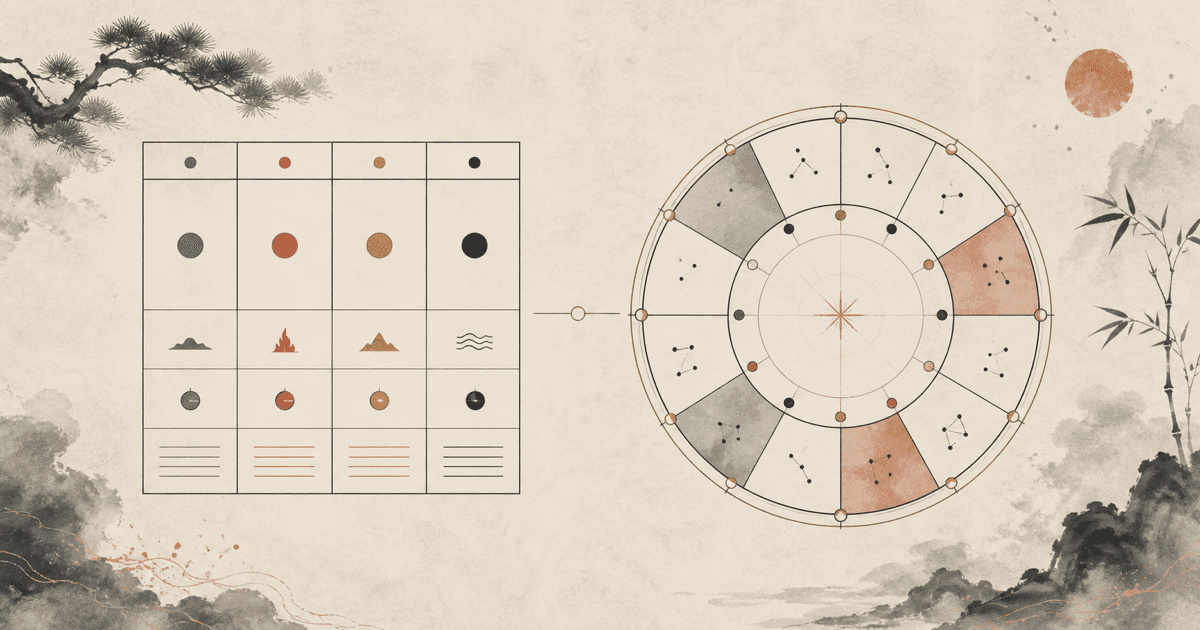
BaZi, also called Four Pillars, organizes birth information into four stem-and-branch pillars and reads their seasonal and element relationships. Zi Wei Dou Shu is a separate Chinese metaphysics system that organizes calculated star placements around palaces. They may use related birth inputs, but their chart outputs, lookup rules, and interpretation methods are not interchangeable.
Search terms this guide answers
How to use this guide with DaoReader
- 1Write down the exact birth date, recorded time, birthplace, and time zone context.
- 2Decide whether you want to study Four Pillars relationships or a palace-and-star layout.
- 3Check which calendar and time assumptions the chosen tool discloses.
- 4Keep the chart output, source method, and terminology attached to the system that produced it.
- 5Compare interpretations as symbolic frameworks rather than competing forecasts.
- 6Use any insight as a reflection prompt and verify real decisions with current evidence.
Two Chinese metaphysics systems, not two names for one chart
BaZi and Zi Wei Dou Shu are often grouped together because both use birth information and are discussed in Chinese metaphysics. That shared setting can hide an important distinction: each system calculates and organizes a chart differently. A useful comparison begins by naming the system on the page, rather than assuming that a result from one chart can be read with the rules of the other.
BaZi centers the Four Pillars and seasonal relationships
A BaZi chart is built from year, month, day, and hour pillars. Each pillar contains a Heavenly Stem and Earthly Branch, and the reading then considers seasonal context, Five Elements, hidden stems, the Day Master, Ten Gods, and branch relationships. The chart is a structured model of these layers, not a list of personality labels or a schedule of future events.
- The month pillar and solar-term context are important to the calculation.
- The Day Master supplies a reference point for many relationship labels.
- A responsible reading keeps visible chart facts separate from interpretation.
- One element or auxiliary star does not replace the complete Four Pillars context.
Zi Wei Dou Shu organizes a palace-and-star chart
Zi Wei Dou Shu uses its own calculation rules to place stars in a set of palaces. Readers commonly encounter a circular or segmented chart rather than a four-column pillar grid. The names, positions, and combinations in that chart belong to Zi Wei Dou Shu's method. A BaZi calculator cannot confirm a Zi Wei placement, and a Zi Wei chart should not be reduced to a BaZi element count.
Decision point
Still comparing the $29 report?
Use this guide as the buying checklist, then move to the sample report or calculator with clearer expectations.
Shared birth details still need method-specific handling
Both systems may ask for a birth date, time, and place, but each tool can apply its own calendar, time-zone, boundary, and lookup conventions. That is why an accurate comparison asks what the tool actually calculates. If a time is unknown or near a boundary, describe that uncertainty instead of presenting a precise symbolic conclusion as settled fact.
Do not turn a comparison into a contest of certainty
It is reasonable to ask which framework feels more useful for studying a particular chart tradition. It is not responsible to claim that one system can prove a personality, identify a spouse, diagnose a condition, guarantee wealth, or forecast an event more accurately. Symbolic systems do not replace evidence about a person, relationship, health, work, finances, or safety.
Choose a clear chart-first path
For a Four Pillars question, start with a transparent BaZi chart and inspect the date, time, place, pillars, and visible relationships before buying a report. DaoReader presents BaZi in English for entertainment and self-reflection. It does not provide a Zi Wei Dou Shu report, medical or mental-health advice, legal advice, financial advice, safety guidance, or deterministic predictions.
BaZi and Zi Wei Dou Shu at a glance
The comparison is about chart architecture and method, not a claim that either framework can establish real-world outcomes.
| Question | BaZi / Four Pillars | Zi Wei Dou Shu |
|---|---|---|
| Primary chart shape | Four time pillars with stems and branches | A palace-based chart with calculated stars |
| Core reading layers | Season, Day Master, elements, Ten Gods, branch relationships | Palaces, star placements, and method-specific combinations |
| What to verify | Birth inputs, calendar boundaries, and pillar calculation | Birth inputs, placement rules, and palace layout |
| Responsible limit | Does not guarantee a personal event or decision outcome | Does not guarantee a life event or decision outcome |
Start with a transparent Four Pillars chart
If your question is about BaZi, calculate the Four Pillars first and inspect the chart context before deciding whether the full English report is useful.
- Review the calculated pillars before checkout.
- See the report structure and limits before paying.
- Use the one-time $29 report as a structured reflection, not a forecast.
Before you leave
Ready to move from reading to your own chart?
The useful next step is the chart-first path: calculate the preview, confirm the birth details, then unlock checkout only if the paid report still makes sense.
Common questions
Is BaZi the same as Zi Wei Dou Shu?
No. They are distinct Chinese metaphysics systems with different chart structures, calculation rules, and interpretation vocabulary.
Do BaZi and Zi Wei Dou Shu use the same birth details?
They may request similar birth details, but each system and tool can apply different calendar, time, and lookup rules. Check the method attached to the chart you are reading.
Which is more accurate, BaZi or Zi Wei Dou Shu?
Neither framework can prove or guarantee personal outcomes. Choose a method for study or reflection, keep its rules visible, and use real evidence for decisions.
Can I combine a BaZi chart with a Zi Wei Dou Shu chart?
You can study them side by side, but do not transfer a label or rule from one system into the other without a source that explicitly defines that cross-system method.
Does DaoReader provide Zi Wei Dou Shu reports?
No. DaoReader focuses on a chart-first English BaZi report and keeps the method, product scope, and responsible-use limits clear.