bazi vs western astrology
BaZi vs Western Astrology: What Is the Difference?
Compare BaZi and Western astrology by their chart frameworks, birth-data handling, interpretation vocabulary, and responsible limits without treating either as a promise about your future.
Report decision
See the Four Pillars before comparing interpretations
Calculate your BaZi chart to see the actual stems, branches, and pillar structure rather than relying on a one-line comparison to a Western sign.
What you will learn
- BaZi is a Four Pillars system rather than a zodiac-sign profile.
- Western astrology and BaZi calculate different chart structures from birth information.
- Birth time and location can matter in both systems, but the boundary rules are not the same.
- Do not translate a planet, sign, house, or BaZi element into an assumed one-to-one equivalent.
- Use charts for entertainment and self-reflection, not as evidence for high-stakes decisions or guaranteed outcomes.
How is BaZi different from Western astrology?
BaZi, or Four Pillars, organizes birth information into year, month, day, and hour pillars made of Heavenly Stems and Earthly Branches, then reads their seasonal and element relationships. Western astrology generally uses a different chart framework based on planetary positions, signs, houses, and aspects. Both are symbolic traditions, but their calculation rules and interpretation vocabulary are not interchangeable.
Search terms this guide answers
How to use this guide with DaoReader
- 1Confirm the exact recorded birth date, time, and birthplace before comparing charts.
- 2Identify whether the result is a Four Pillars grid or a Western birth-chart wheel.
- 3Read the calculation notes for time zone, calendar, and boundary assumptions.
- 4Keep each system's terms inside its original chart method.
- 5Ask what the chart visibly shows before accepting an interpretation.
- 6Use external evidence and qualified advice for real medical, legal, financial, relationship, or safety decisions.
The systems use different chart languages
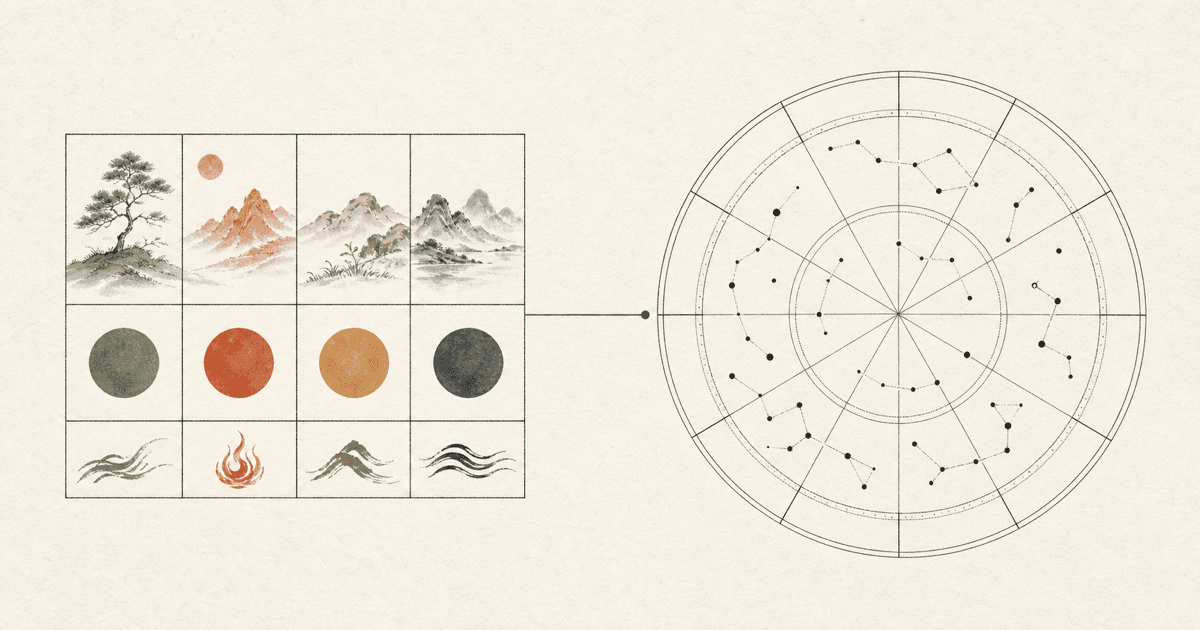
BaZi and Western astrology are both commonly introduced through birth information, but the resemblance stops there. BaZi presents four pillars that contain stems and branches. Western astrology usually presents a circular chart of planetary positions and other geometric relationships. A comparison is clearest when it starts from those visible structures instead of treating both as versions of the same zodiac personality test.
BaZi reads a Four Pillars structure
The BaZi calculation produces year, month, day, and hour pillars. A responsible reading considers the Day Master, seasonal command, Five Elements, hidden stems, Ten Gods, and branch relationships. It is not enough to know a birth-year animal or one element. The full chart context matters, and the calculation should expose the inputs and boundary assumptions that created it.
- The Day Master is a reference within the BaZi chart, not a Western sun sign equivalent.
- The month pillar uses BaZi calendar rules and seasonal boundaries.
- Elements describe relationships inside the chart method, not fixed personality types.
- Auxiliary stars are later chart layers, not a replacement for the pillars.
Western astrology uses another calculation framework
Western astrology typically describes a birth chart using positions of celestial bodies, signs, houses, and aspects. Traditions inside Western astrology can also differ in settings and techniques. Those terms do not map automatically to BaZi stems, branches, Ten Gods, or luck pillars. When a website makes a direct equivalence without showing a method, treat it as a loose metaphor rather than a reliable calculation.
Decision point
Still comparing the $29 report?
Use this guide as the buying checklist, then move to the sample report or calculator with clearer expectations.
Birth time matters for different reasons
Both frameworks may request a birth time and place, especially when the time is close to a chart boundary. In BaZi, the hour pillar and solar-term-related timing rules are part of the calculation. In Western astrology, birth time can affect the chart layout used by that tradition. A missing or uncertain time should remain visible as uncertainty instead of being hidden under confident labels.
Avoid one-to-one translations
It is tempting to ask which BaZi element is a Western sign, or which planet is a Ten God. Those shortcuts remove the network of rules that gives each label a role. You can compare broad themes for study, but do not use a loose analogy to invent a chart fact, verify a prediction, or declare that two different calculations agree.
Keep symbolic reflection separate from evidence
A chart can be used as a structured prompt for reflection, language, and curiosity. It cannot establish health, intelligence, compatibility, legal exposure, financial prospects, a spouse, a career outcome, or a future date. DaoReader presents BaZi in English for entertainment and self-reflection and makes the calculated chart visible before its one-time $29 report.
BaZi and Western astrology: method-level comparison
These are high-level distinctions. They do not turn either symbolic system into a testable predictor of real-world outcomes.
| Comparison point | BaZi / Four Pillars | Western astrology |
|---|---|---|
| Visible chart structure | Four vertical pillars of stems and branches | A circular birth chart with method-specific positions and divisions |
| Core vocabulary | Day Master, elements, Ten Gods, branches, seasonal context | Planets, signs, houses, aspects, and tradition-specific techniques |
| Time handling | Hour pillar and calendar or solar-term boundaries | Birth-chart settings and time-sensitive chart placement |
| Responsible use | A symbolic reflection framework, not a prediction engine | A symbolic reflection framework, not a decision engine |
See the Four Pillars before comparing interpretations
Calculate your BaZi chart to see the actual stems, branches, and pillar structure rather than relying on a one-line comparison to a Western sign.
- Enter birth details once and inspect the calculated chart context.
- Read the method and limits before accepting a symbolic label.
- Preview the $29 English report before checkout.
Before you leave
Ready to move from reading to your own chart?
The useful next step is the chart-first path: calculate the preview, confirm the birth details, then unlock checkout only if the paid report still makes sense.
Common questions
Is BaZi Chinese astrology?
BaZi is often described as Chinese astrology or Chinese metaphysics. More specifically, it is a Four Pillars system with its own stems, branches, calendar rules, and reading methods.
What is the Western astrology equivalent of the BaZi Day Master?
There is no direct one-to-one equivalent. The Day Master is a BaZi reference within a system of elements, stems, branches, and seasonal context.
Do I need my birth time for BaZi?
A known birth time supports calculation of the hour pillar and helps when the birth moment is near a boundary. If the time is uncertain, keep that uncertainty visible in the chart process.
Can BaZi and Western astrology predict the same event?
No chart comparison can prove or guarantee an event. Avoid treating agreement between symbolic labels as evidence for a future outcome.
Can I use BaZi for career, health, or relationship decisions?
No. Use DaoReader only for entertainment and self-reflection. Important decisions require direct evidence, communication, and qualified professional support where appropriate.