bazi vs feng shui
BaZi vs Feng Shui: What Is the Difference?
Learn how BaZi and Feng Shui differ in their inputs, chart or space focus, and responsible limits so a birth chart is not mistaken for a property assessment.
Report decision
Calculate the birth-chart side first
Use the calculator to see the Four Pillars generated from your birth details, then decide whether a full English BaZi report is useful for reflection.
What you will learn
- BaZi is chart-first: it derives Four Pillars from birth information.
- Feng Shui is environment-first: it evaluates a physical setting with its own methods.
- Shared Five Element vocabulary does not make the systems interchangeable.
- A BaZi calculator cannot audit a house, desk direction, property, or renovation plan.
- Do not use either symbolic system as a substitute for professional property, legal, financial, health, or safety advice.
What is the difference between BaZi and Feng Shui?
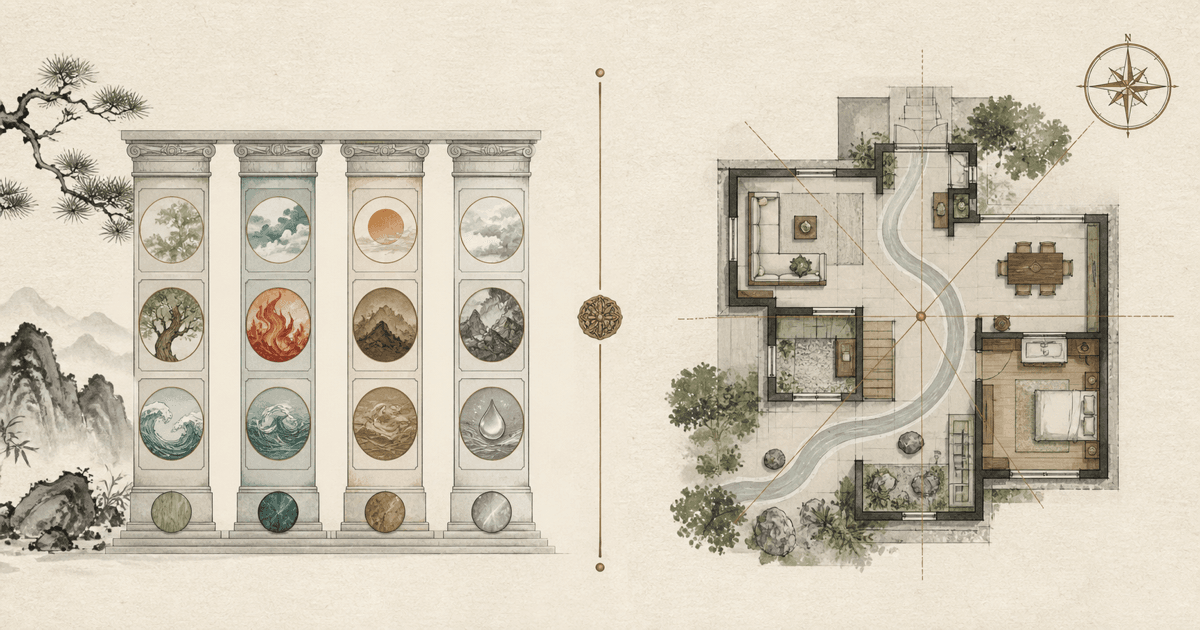
BaZi is a Four Pillars birth-chart system that starts from a person's birth date, time, and place. Feng Shui is a separate set of practices for studying environmental context such as a site, building, room, direction, and layout. Both may use traditional Five Element language, but a BaZi chart cannot inspect a home and a Feng Shui review cannot replace a birth-chart calculation.
Search terms this guide answers
How to use this guide with DaoReader
- 1Identify the actual question: birth-chart reflection or a physical-space question.
- 2For BaZi, confirm the date, time, birthplace, and calculated Four Pillars.
- 3For Feng Shui, define the real site, room, orientation, layout, and observation method.
- 4Keep the terminology and evidence inside the system that produced it.
- 5Do not use a shared element label to infer a property remedy or a personal outcome.
- 6Use qualified evidence for decisions about housing, money, health, safety, or legal obligations.
BaZi and Feng Shui answer different kinds of questions
BaZi and Feng Shui are often introduced together, which makes it easy to assume they perform the same task. BaZi begins with birth information and derives a Four Pillars chart. Feng Shui begins with a physical environment and uses its own approaches to direction, form, layout, and context. The object being studied is different before any interpretation begins.
BaZi is a birth-chart method
A BaZi calculator uses birth date, birth time, birthplace, calendar rules, and time handling to calculate the year, month, day, and hour pillars. A careful reading then looks at chart structure, seasonal context, elements, and relationships. It can frame symbolic questions about a chart, but it cannot see a room, measure a building, or make a site-specific recommendation.
- The starting evidence is a transparent Four Pillars chart.
- A birth-time correction question belongs to the calculation stage.
- The report should separate chart facts from interpretive language.
- BaZi is not a property inspection or a construction recommendation.
Feng Shui is an environmental method
Feng Shui discussions normally require information about a real place: its location, orientation, physical form, rooms, entry points, and surroundings. Schools differ in what they emphasize and how they measure it. Those inputs do not exist in a BaZi chart, so a chart result cannot responsibly be converted into instructions to move furniture, buy an object, select a property, or change a building.
Decision point
Still comparing the $29 report?
Use this guide as the buying checklist, then move to the sample report or calculator with clearer expectations.
Five Elements are a shared language, not a universal remedy system
Traditional element language appears in several Chinese metaphysics systems. In BaZi, element relationships are read inside the Four Pillars and the Day Master context. In Feng Shui, a school may use element language in a physical-environment framework. Treating an element word as an automatic color, object, direction, purchase, or life solution removes the method that gave the word meaning in the first place.
Keep products and decisions inside their evidence boundary
A chart-first report can explain what it calculated and how it frames symbolic reflection. It cannot assess whether a home is safe, whether a property is a sound purchase, whether a renovation is suitable, or whether a business decision will work. Those decisions require inspection, legal and financial information, local rules, and professional judgment.
Use a clear path instead of mixing services
If you want to understand your Four Pillars, calculate the chart and check the result before choosing a report. If you need a real-world environmental assessment, seek an appropriate qualified professional and current evidence. DaoReader provides an English BaZi report for entertainment and self-reflection; it does not provide Feng Shui audits, remedies, property advice, or outcome guarantees.
BaZi and Feng Shui compared by their starting evidence
The systems can appear near each other in traditional Chinese metaphysics, but they require different inputs and have different responsible limits.
| Question | BaZi / Four Pillars | Feng Shui |
|---|---|---|
| Object being studied | A birth-chart structure | A physical site, building, room, or layout |
| Starting inputs | Birth date, time, place, and calendar handling | Location, orientation, form, layout, and observed context |
| What the method can show | Calculated pillars and symbolic chart relationships | Method-specific environmental observations |
| What it cannot replace | A property, safety, or building assessment | A transparent birth-chart calculation |
Calculate the birth-chart side first
Use the calculator to see the Four Pillars generated from your birth details, then decide whether a full English BaZi report is useful for reflection.
- Check the chart before any report purchase.
- Keep chart interpretation separate from property decisions.
- Preview the one-time $29 report and its responsible limits.
Before you leave
Ready to move from reading to your own chart?
The useful next step is the chart-first path: calculate the preview, confirm the birth details, then unlock checkout only if the paid report still makes sense.
Common questions
Is BaZi part of Feng Shui?
They are separate systems that may be discussed within Chinese metaphysics. BaZi is a Four Pillars birth-chart method, while Feng Shui evaluates a physical environment through different inputs and rules.
Can a BaZi chart tell me how to arrange my home?
No. A BaZi chart does not inspect a home's orientation, layout, condition, or surroundings, so it cannot provide a reliable environmental assessment or remedy plan.
Do BaZi and Feng Shui both use the Five Elements?
They can use related traditional element vocabulary, but the role of an element must be read within the specific method. A shared word does not make the analysis interchangeable.
Can Feng Shui replace a BaZi reading?
No. Feng Shui is not a birth-chart calculation. A transparent BaZi reading begins with the four pillars derived from birth information.
Does DaoReader provide Feng Shui advice?
No. DaoReader provides a chart-first English BaZi report for entertainment and self-reflection, not space audits, remedies, property advice, or guarantees.