does bazi use solar or lunar calendar
Does BaZi Use a Solar or Lunar Calendar?
Learn why BaZi calendar handling often follows solar-term boundaries, how that differs from Lunar New Year, and what birth time and birthplace checks a transparent calculator should show.
Report decision
Calculate with the birth details you can verify
Enter your date, known birth time, and birthplace to review the calculated Four Pillars before deciding whether the English report is useful.
What you will learn
- BaZi calendar handling is not the same as choosing between a modern Gregorian date and a lunar-date label.
- Many Four Pillars methods use solar terms to define the year and month pillar boundaries.
- Lunar New Year is not automatically the BaZi year-pillar boundary in those methods.
- Birth time, birthplace, time zone, and boundary timestamps matter near transitions.
- True solar time is a separate location-based question from solar-term calendar boundaries.
Does BaZi use a solar or lunar calendar?
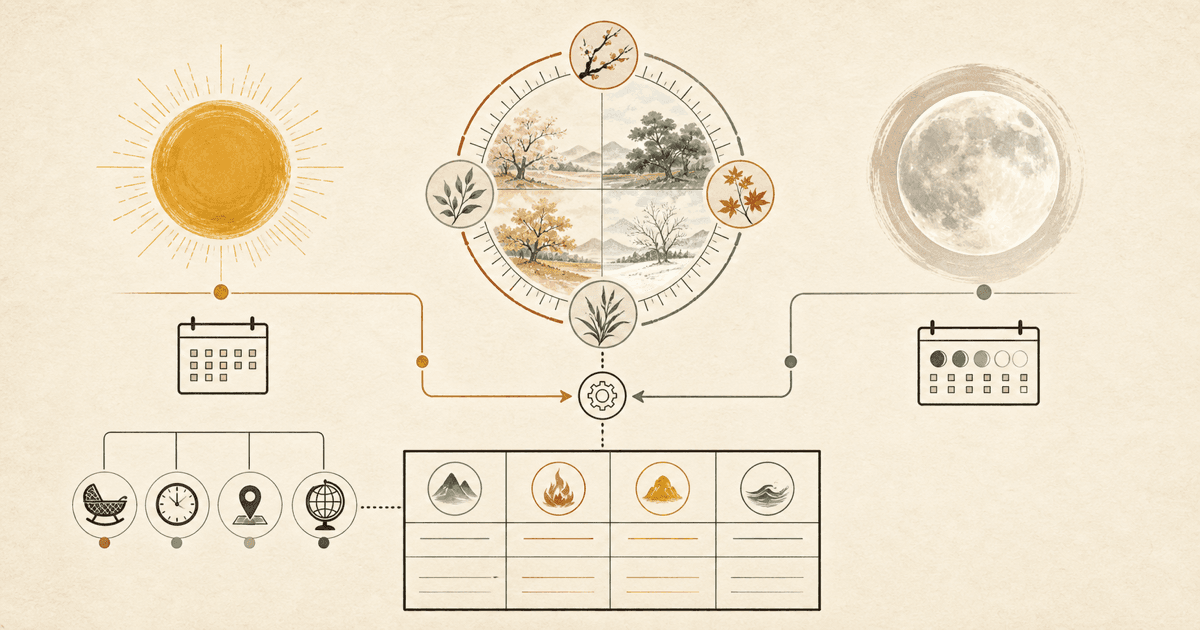
Many Four Pillars methods use solar-term boundaries for the BaZi year and month pillars rather than switching automatically at Lunar New Year or on the first day of a Gregorian month. The exact result depends on the method, local birth date and time, birthplace, time zone, and any disclosed solar-time convention. A trustworthy calculator should state its rule instead of calling every Chinese-calendar date simply lunar.
Search terms this guide answers
How to use this guide with DaoReader
- 1Start with the recorded local birth date, time, and birthplace.
- 2Confirm the time zone and historical daylight-saving context if relevant.
- 3Ask whether the calculator uses solar terms for its year and month boundaries.
- 4Check the output carefully if the birth moment is near Li Chun or another solar-term transition.
- 5Keep a true-solar-time correction separate from the question of lunar versus solar calendar rules.
- 6Record uncertainty instead of treating a boundary case as a fixed prediction.
BaZi calendar questions need more than a lunar-date label
A birth record may be written in a Gregorian date, a Chinese lunar date, or a family notation, but a BaZi calculation still needs a defined conversion method. The important question is which boundary rules the Four Pillars method uses for the year and month pillars. A transparent tool explains its approach instead of implying that every Chinese astrology calculation changes on Lunar New Year.
Solar terms often define the year and month boundaries
In many Four Pillars conventions, the year and month pillars are organized around solar terms. That means the transition can occur at a specific moment rather than at midnight on January 1, on a Gregorian month change, or at Lunar New Year. A calculator should state this choice so a reader knows why a chart near a boundary may differ from a general zodiac-year list.
- Look for a stated solar-term or seasonal-boundary rule.
- Check the exact local time when a birth is close to a transition.
- Do not assume a zodiac year begins at the same moment in every system.
- Treat a boundary result as a calculation question before interpreting it.
Lunar New Year and a BaZi year boundary are not always the same
Lunar New Year has an important cultural calendar role, but it is not automatically the year-pillar switch in a Four Pillars method that uses solar terms. This is why people born around the beginning of a calendar year can see different labels in a simple zodiac tool and a BaZi calculator. The difference is a stated convention, not proof that one person has two destinies.
Decision point
Still comparing the $29 report?
Use this guide as the buying checklist, then move to the sample report or calculator with clearer expectations.
Birth time and place matter most near a transition
A date without a time can be enough for many everyday records, but it can be incomplete for a chart calculation near a solar-term or hour-pillar boundary. The local time, birthplace, time zone, and daylight-saving history can affect the interpreted moment. When the record is uncertain, show the uncertainty and consider alternate chart possibilities rather than forcing a precise result.
True solar time is a separate calculation choice
True solar time concerns whether a source adjusts clock time by local longitude or another stated convention. It is not another name for a solar-term calendar, and it does not make a lunar-date conversion unnecessary. A careful workflow first identifies the calendar boundary rule, then separately states any time correction used by the calculation.
Use calendar precision to improve transparency, not certainty
Correct inputs help a calculator produce a reproducible chart, but a more precise chart is still a symbolic framework. It cannot prove personality, diagnose health, choose a partner, guarantee money, or schedule an event. DaoReader uses birth details to calculate Four Pillars and presents the result for entertainment and self-reflection, not high-stakes decisions or deterministic prediction.
Calendar terms that a BaZi calculator should keep separate
A clear calculation labels each input and convention instead of collapsing several calendar questions into the word lunar.
| Term | What it controls | What it does not establish |
|---|---|---|
| Solar-term boundary | A stated year or month transition in many Four Pillars methods | A guaranteed life event or personality change |
| Lunar New Year | A cultural lunar-calendar new year date | An automatic BaZi year-pillar boundary in every method |
| Recorded birth time | The local clock moment used to calculate the hour context | Proof that an uncertain memory is exact |
| True solar time | A separately stated local-time adjustment convention | A replacement for calendar conversion or birth-place data |
Calculate with the birth details you can verify
Enter your date, known birth time, and birthplace to review the calculated Four Pillars before deciding whether the English report is useful.
- Keep uncertain birth times visible instead of guessing.
- Review the chart result before purchasing a report.
- Preview the one-time $29 report and its responsible-use limits.
Before you leave
Ready to move from reading to your own chart?
The useful next step is the chart-first path: calculate the preview, confirm the birth details, then unlock checkout only if the paid report still makes sense.
Common questions
Does BaZi use the lunar calendar?
A BaZi calculator may accept or convert Chinese-calendar dates, but many Four Pillars methods use solar-term boundaries for year and month pillars. Check the exact rule used by the tool.
Does the BaZi year start on Lunar New Year?
Not necessarily. In methods that use solar terms, the relevant year-pillar boundary can occur at a stated solar-term transition instead of Lunar New Year.
Why do two BaZi calculators give different results near Lunar New Year?
They may use different calendar boundaries, time zones, birth-place handling, or time-adjustment conventions. Compare the disclosed calculation methods before interpreting the difference.
Is true solar time the same as a solar calendar?
No. True solar time is a separately stated local-time adjustment. Solar-term calendar boundaries concern how a Four Pillars method defines certain transitions.
What should I do if my birth time is uncertain?
Do not invent an exact time. Use the best available record, note uncertainty, and treat near-boundary results as provisional rather than using them for a high-stakes decision.