BaZi Punishment meaning
BaZi Punishment: Meaning, Context, and Careful Reading
Understand BaZi Punishment branch relationships, the common pattern families, and why a Punishment cannot predict harm, crime, illness, or punishment events.
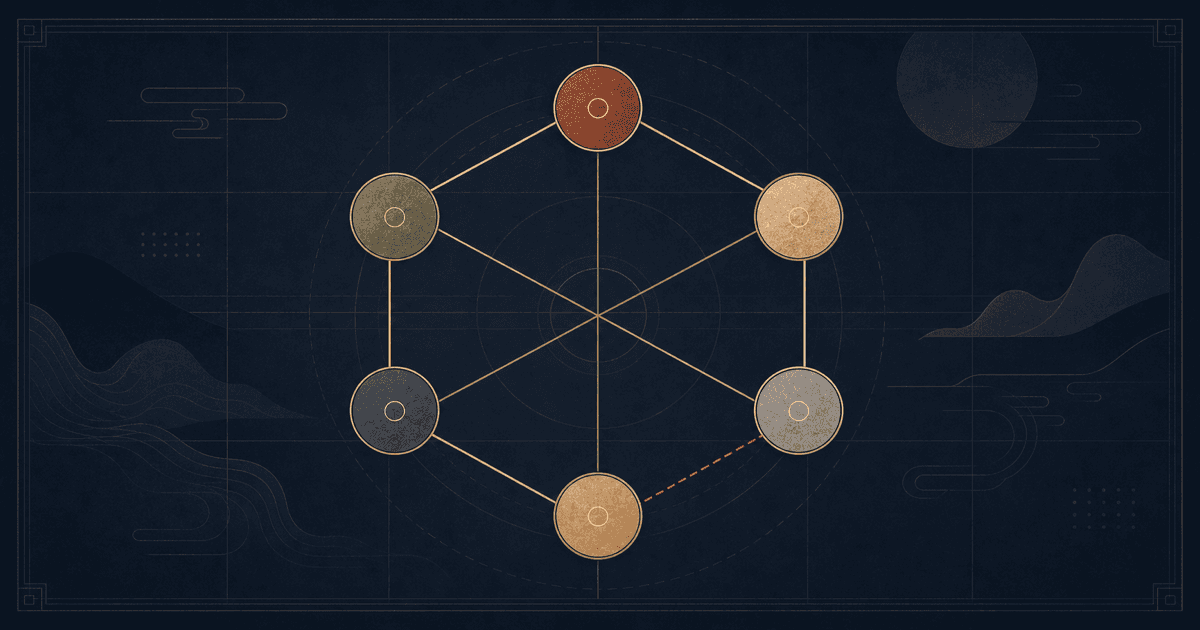
Report decision
Check the actual branches before interpreting the label
Build the complete chart, identify which layer supplies each branch, and place the relationship inside the wider reading.
What you will learn
- Punishment is a defined branch relationship, not the ordinary meaning of the English word.
- Different pattern families require different branch conditions.
- A partial set should not be presented as though the complete pattern were present.
- Natal and timing-layer relationships must be identified separately.
- No Punishment pattern can diagnose danger or guarantee an event.
What does Punishment mean in BaZi?
Punishment is a traditional name for specific Earthly Branch relationships. Depending on the method, it may involve a three-branch set, a two-branch pattern, or a repeated branch sometimes called self-punishment. It is a symbolic structural label, not a forecast of legal punishment, violence, illness, self-harm, or inevitable misfortune.
Search terms this guide answers
How to use this guide with DaoReader
- 1Write down all four natal Earthly Branches.
- 2Name the exact Punishment family used by the source.
- 3Check whether the required branches and repetitions are actually present.
- 4Separate natal structure from luck-pillar or annual activation.
- 5Review combinations, clashes, season, and the rest of the chart.
- 6Translate the symbol into a modest reflection question, not a warning.
Punishment is technical vocabulary
The translated word Punishment can sound moral, legal, or threatening. In BaZi it names particular branch configurations. The label does not say that a person deserves punishment or will punish themselves or others. A reader should first identify the branch rule, then explain its limits before discussing any symbolic theme.
Common pattern families should stay distinct
Traditional references may group Punishments into named families, including a three-branch configuration, a two-branch configuration, and repeated-branch patterns often translated as self-punishment. Terminology and completion rules can vary. State the exact branches and method rather than treating every pair of difficult-looking branches as the same relationship.
- Check whether a pattern requires two or three distinct branches.
- Do not silently upgrade a partial configuration to a complete one.
- Record repeated branches precisely for a self-punishment claim.
- Keep translation choices and school differences visible.
Natal and timing relationships answer different questions
A natal pattern comes from the birth chart. A luck pillar or annual branch can create a temporary relationship with natal branches. A responsible reading names which layer supplies each branch. The timing match may be used as a period for reflection, but it does not schedule an accident, dispute, diagnosis, loss, or punishment.
Decision point
Still comparing the $29 report?
Use this guide as the buying checklist, then move to the sample report or calculator with clearer expectations.
Context can change the symbolic emphasis
Branch relationships sit inside a larger structure that includes season, hidden stems, combinations, clashes, harms, and the functions of the elements involved. Competing relationships may change which pattern a school emphasizes. This is why a single red icon in software is not a complete interpretation.
Safer reflection questions
If a reader uses Punishment symbolically, useful questions can concern repeated friction, internal standards, avoidable pressure, or a pattern that benefits from a slower response. These prompts should be tested against lived experience. They should never become accusations about criminality, aggression, illness, trauma, or self-harm.
Hard limits for decisions and safety
BaZi Punishment is not a risk assessment. Do not use it to make medical, mental-health, legal, financial, relationship, travel, or safety decisions. If there is a real concern, rely on qualified professionals and current evidence. DaoReader uses BaZi only for entertainment and self-reflection.
How to separate Punishment contexts
Name the relationship and chart layer before attempting any interpretation.
| Context | What to verify | What it cannot prove |
|---|---|---|
| Natal pattern | Required branches appear in the birth chart | A fixed personality flaw or harmful fate |
| Partial pattern | Only part of a multi-branch rule is present | That the complete configuration exists |
| Repeated branch | The method recognizes the specific repetition | Self-harm, guilt, or self-sabotage |
| Timing-layer pattern | A luck or annual branch supplies a temporary match | A dated accident, illness, dispute, or penalty |
Check the actual branches before interpreting the label
Build the complete chart, identify which layer supplies each branch, and place the relationship inside the wider reading.
- Verify the Four Pillars and branch names.
- Distinguish complete, partial, natal, and timing patterns.
- Use the $29 report only as a bounded self-reflection tool.
Before you leave
Ready to move from reading to your own chart?
The useful next step is the chart-first path: calculate the preview, confirm the birth details, then unlock checkout only if the paid report still makes sense.
Common questions
Does BaZi Punishment mean something bad will happen?
No. It is a traditional branch-relationship label, not a forecast of a harmful event or proof that a period will be bad.
What is self-punishment in BaZi?
Self-punishment is a translation used for certain repeated-branch rules. It does not diagnose self-harm, guilt, mental illness, or self-sabotage.
Can an annual branch create a Punishment?
Some methods read an annual branch in relation to natal branches. That is a temporary symbolic relationship and does not predict a specific event during the year.
Is a partial Punishment the same as a complete pattern?
No. If a method requires a larger branch set, the missing branch matters. State the partial configuration accurately instead of presenting it as complete.
Can BaZi Punishment predict legal trouble or illness?
No. It cannot assess legal, medical, mental-health, financial, or safety risk. Use qualified advice and real evidence for those concerns.