BaZi compatibility without match scores
BaZi Compatibility Without Match Scores
Learn how to use BaZi compatibility for relationship reflection without fixed match scores, soulmate claims, or deterministic relationship advice.
Report decision
Use compatibility as reflection, not a verdict
DaoReader's compatibility path keeps the focus on chart context, relationship patterns, and responsible limits instead of fixed match scores.
What you will learn
- A compatibility score can make a complex relationship look falsely simple.
- BaZi can support reflection on communication, needs, pressure, and timing themes.
- Consent and privacy matter when entering another person's birth details.
- Compatibility should not be used to control, pressure, or judge a partner.
- A responsible reading avoids soulmate claims and fixed relationship verdicts.
Should BaZi compatibility use match scores?
BaZi compatibility is more responsible when it avoids fixed match scores. A useful reading can compare communication patterns, support needs, pressure responses, and timing themes, but it should not decide whether a relationship will last, whether someone is a soulmate, or what a couple must do.
Search terms this guide answers
How to use this guide with DaoReader
- 1Confirm that both people consent to using their birth details.
- 2Calculate each chart and note uncertainty around birth time.
- 3Compare communication and pressure patterns rather than looking for a score.
- 4Use compatibility themes as conversation prompts.
- 5Avoid treating timing themes as a deadline or prediction.
- 6Keep relationship decisions grounded in real behavior, values, safety, and communication.
Why match scores are misleading
A single BaZi compatibility score can feel convenient, but it hides the actual comparison. Relationships are shaped by communication, choices, life context, consent, safety, values, and timing. A score cannot responsibly decide those things.
- A high score can create false confidence.
- A low score can create unnecessary fear.
- A number can distract from real conversations and behavior.
What compatibility can compare instead
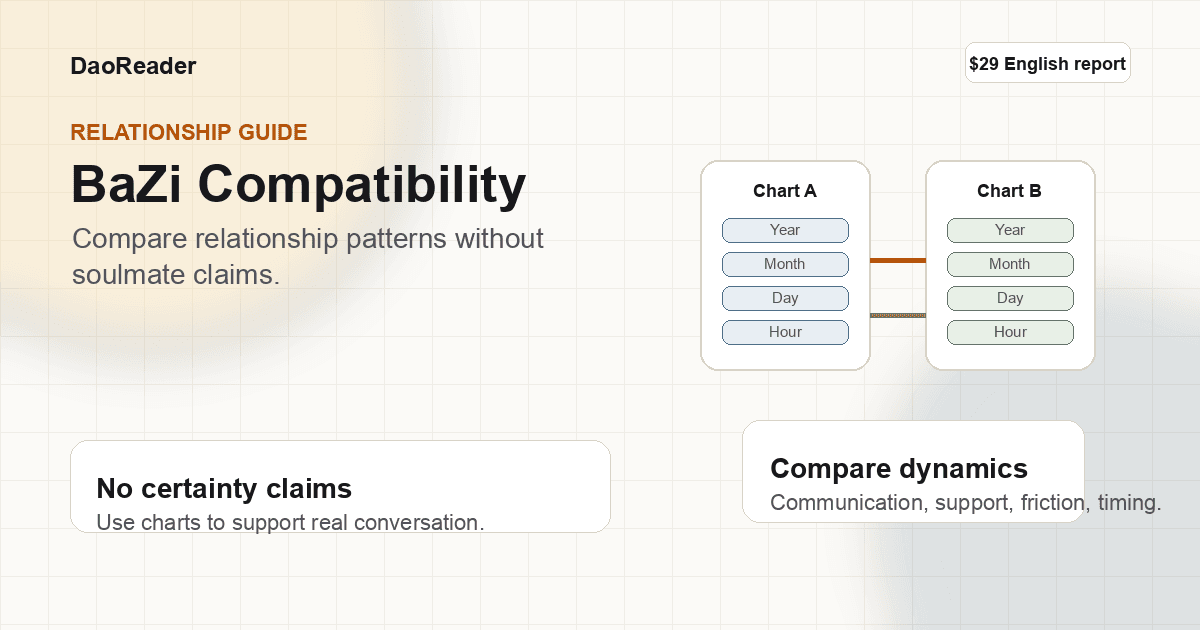
A more useful compatibility reading compares patterns. It can look at how each chart may express pressure, support, pace, independence, directness, planning, or emotional needs, then frame those observations as prompts for discussion.
- Communication style and conflict response.
- Support needs and expectations.
- Pace, stability, and change tolerance.
- Timing themes that may affect attention or stress.
Consent and privacy come first
A relationship reading uses personal birth information. If you are entering another person's details, treat that information with care and avoid using a reading as a way to test, judge, pressure, or monitor them.
- Ask before using another person's birth data.
- Do not use a reading to justify control or suspicion.
- Share only what is respectful and useful for conversation.
Decision point
Still comparing the $29 report?
Use this guide as the buying checklist, then move to the sample report or calculator with clearer expectations.
BaZi compatibility vs zodiac compatibility
Chinese zodiac compatibility usually starts from the birth year animal. BaZi compatibility uses the wider Four Pillars chart, including the Day Master, month context, elements, branches, hidden stems, and timing layers. That makes it richer, but still not deterministic.
Prompts to use in a real conversation
The best output from a compatibility reading is not a verdict. It is a set of questions that help both people talk with more clarity.
- Where do we each need steadiness, space, or directness?
- What kinds of stress make us less generous with each other?
- Which differences are complementary, and which need explicit agreements?
- What support would make difficult periods easier to navigate?
What compatibility should never decide
A BaZi compatibility reading should not decide whether to marry, leave, trust, forgive, or stay in an unsafe situation. It should never replace communication, consent, professional support, or safety planning.
Score-based compatibility vs reflective compatibility
If you are comparing compatibility pages, check whether the page turns the reading into a score or keeps the focus on patterns and conversation.
| Approach | Stronger use | Risky use |
|---|---|---|
| Match score | Avoid or treat as entertainment only | Treat as a relationship verdict |
| Chart comparison | Compare patterns and needs | Rank one person as better or worse |
| Timing themes | Use as stress-awareness prompts | Predict exact breakups or outcomes |
| Relationship advice | Suggest questions for conversation | Tell people what they must do |
| Privacy | Use birth data with consent | Enter someone else's data secretly |
Use compatibility as reflection, not a verdict
DaoReader's compatibility path keeps the focus on chart context, relationship patterns, and responsible limits instead of fixed match scores.
- No soulmate guarantee or fixed marriage verdict.
- Plain-English compatibility themes with boundaries.
- Birth details and chart context stay visible before checkout.
Before you leave
Ready to move from reading to your own chart?
The useful next step is the chart-first path: calculate the preview, confirm the birth details, then unlock checkout only if the paid report still makes sense.
Common questions
Does BaZi compatibility give a percentage score?
DaoReader avoids fixed compatibility scores because they can overstate certainty. A reflective reading is more useful when it compares patterns and prompts conversation.
Can BaZi tell if someone is my soulmate?
No. A responsible BaZi compatibility reading should not make soulmate claims or decide relationship outcomes.
Is BaZi compatibility the same as Chinese zodiac compatibility?
No. Zodiac compatibility often uses the birth year animal, while BaZi uses the fuller Four Pillars chart. BaZi is richer, but still should be framed reflectively.
Can I use someone else's birth details?
Use care and consent. Birth data is personal information, and a reading should not be used to pressure, judge, or control another person.