can bazi predict yearly luck
BaZi Annual Pillar: Yearly Timing Themes Explained
Learn what a BaZi annual pillar means, how yearly stems and branches interact with natal and Da Yun context, and why yearly themes are not fixed forecasts.
Report decision
Turn annual timing searches into chart-first context
If you are checking the annual pillar for the current year, calculate the natal chart and compare DaoReader's sample before treating any yearly language as useful.
What you will learn
- An annual pillar adds one year's stem and branch to the chart conversation.
- Annual timing should be read against the natal chart and Da Yun cycle.
- A yearly BaZi forecast should not be treated as a fixed prediction.
- The same annual pillar can mean different reflection themes for different charts.
- DaoReader uses annual timing as a way to organize review questions, not as advice for high-stakes choices.
What is an annual pillar in BaZi?
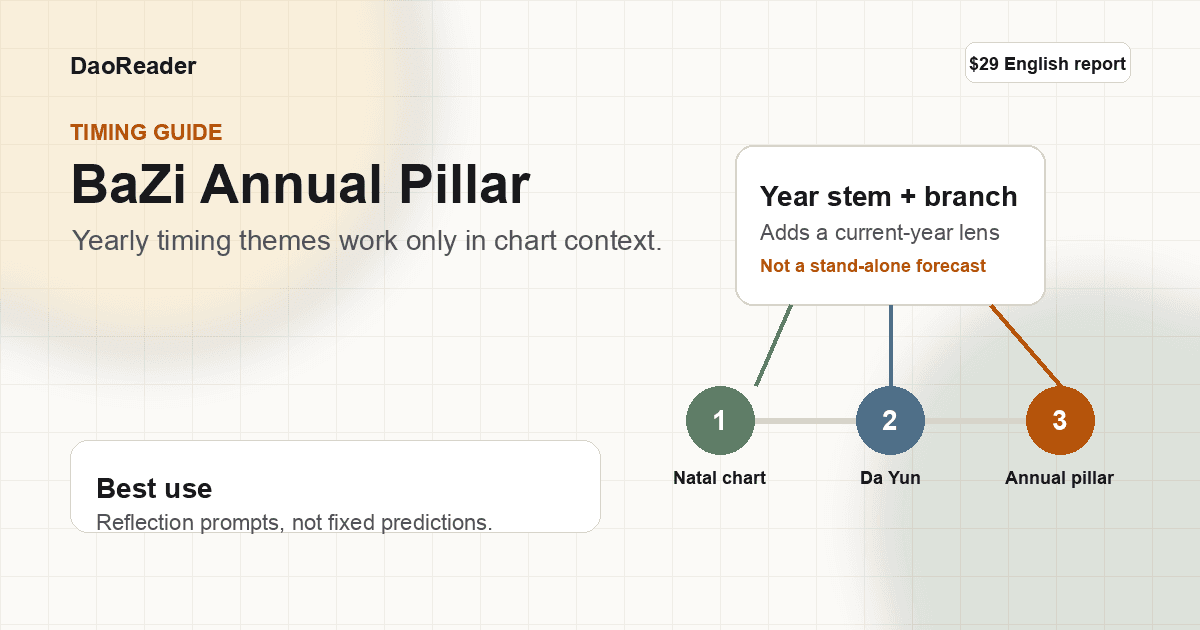
A BaZi annual pillar is the Heavenly Stem and Earthly Branch associated with a calendar year. It adds yearly timing context when compared with the natal Four Pillars and current Da Yun cycle. It does not predict events by itself or make the year good or bad for everyone.
Search terms this guide answers
How to use this guide with DaoReader
- 1Identify the stem and branch for the year being reviewed.
- 2Compare that annual pillar with the natal Four Pillars.
- 3Check whether the current Da Yun cycle reinforces or softens the annual theme.
- 4Look for repeated elements, combinations, or tensions.
- 5Translate the pattern into practical reflection questions.
- 6Avoid using annual timing as medical, legal, financial, safety, or guaranteed-outcome advice.
Annual pillar vs yearly fortune
People often search annual BaZi content because they want to understand the year ahead. Search phrases like yearly BaZi forecast or BaZi annual luck can sound predictive, but the annual pillar is only one timing layer. It provides a symbolic lens, not a complete verdict about a year.
- The annual pillar is shared by everyone in the same calendar year.
- Personal meaning comes from how it interacts with the natal chart.
- The current Da Yun cycle adds another layer before interpretation is useful.
How annual themes interact with the natal chart
The annual stem and branch may highlight elements already present in the natal chart, introduce a low-visible element, or create contrast with the Day Master. The meaning depends on the whole chart. A repeated element can make a familiar pattern louder, while a new element can become a reflection topic without becoming a remedy.
- A repeated element may make a familiar theme more visible.
- A new element may introduce a different kind of pressure or support.
- A branch interaction may point to a theme worth reviewing, not a guaranteed event.
Why the Da Yun cycle matters before annual timing
An annual pillar is easier to read after the current Da Yun cycle is understood. The 10-year cycle can set the broader symbolic weather, while the annual pillar may add a shorter emphasis. If both layers point to similar elements, the theme may deserve more review. If they contrast, the reading should explain mixed signals rather than forcing a simple forecast.
Why annual BaZi should not make decisions for you
Annual BaZi language can support reflection, but it should not decide whether someone changes jobs, starts a business, ends a relationship, moves countries, invests money, ignores medical care, or takes legal action. Those choices need real-world information, consent where relevant, and qualified advice when stakes are high.
Use annual themes as reflection prompts
A practical annual pillar reading turns chart language into questions. What theme is becoming louder? What pattern needs more awareness? What support or pressure should be reviewed with care? This keeps the annual timing useful without turning it into a deterministic horoscope.
- Review repeated themes instead of chasing lucky dates.
- Notice tension points without assuming bad outcomes.
- Use the report as a structured reflection tool, not a substitute for judgment.
How DaoReader connects annual timing to the report path
DaoReader asks users to calculate the chart first, then inspect the report style. Annual timing appears as context connected to the natal chart and Da Yun cycle. If that careful framing matches what you want, the $29 report can turn the chart into a structured English reading.
Direct answer for whether BaZi can predict yearly luck
BaZi should not be treated as a fixed yearly luck forecast. The annual pillar can describe timing themes when it is read against the natal chart and current Da Yun cycle, but it cannot promise whether a year will be lucky, unlucky, safe, profitable, or successful.
- Use yearly timing as a reflection lens, not a verdict.
- Compare the annual pillar with natal and Da Yun context.
- Avoid using yearly BaZi language for high-stakes choices.
How responsible yearly luck timing connects to the full BaZi chart
Yearly timing only makes sense after the full chart is visible. The annual stem and branch may highlight a theme, but that theme changes depending on the Day Master, season, elements, branch interactions, and current Da Yun cycle.
- Start with the natal Four Pillars before annual timing.
- Use Da Yun as the broader timing layer.
- Treat repeated or contrasting elements as questions to review, not guaranteed events.
What yearly luck timing language can and cannot responsibly explain
Yearly luck language can help organize reflection around pressure, support, repeated themes, and timing awareness. It cannot decide medical, legal, financial, safety, career, relocation, or relationship actions.
- Do not use annual timing as a lucky-date engine.
- Do not treat a year as good or bad for everyone.
- Keep qualified advice outside the BaZi report.
Decision point
Still comparing the $29 report?
Use this guide as the buying checklist, then move to the sample report or calculator with clearer expectations.
Calculator and sample-report next steps
If you are asking whether BaZi can predict yearly luck, use the calculator to confirm the natal chart first. Then read the sample report to see how DaoReader phrases timing themes before deciding whether the $29 report is useful.
- Use calculator output as the evidence layer.
- Use the sample report to reduce uncertainty before payment.
- Make checkout a continuation of the same birth details, not a separate flow.
Timing language without fixed event prediction
A responsible yearly timing page answers the prediction question directly: BaZi can frame timing themes, but DaoReader does not sell fixed forecasts. The useful output is a set of careful questions, not a promised result.
- Name the chart facts a reader can verify on the page.
- Explain what the calculator can show before payment and what the report adds.
- Keep the page inside entertainment and self-reflection, not deterministic advice.
How luck cycles and annual context change the reading
Luck Pillars describe the broader 10-year cycle, while the annual pillar adds a shorter yearly layer. When both point to similar themes, the report can explain why the topic is more visible; when they differ, the report should describe mixed signals rather than forcing certainty.
- Read Da Yun before annual timing.
- Use annual context to refine reflection prompts.
- Avoid turning timing language into a fixed event forecast.
Direct answer for BaZi annual luck
For bazi annual luck, the useful starting point is chart evidence the reader can verify: birth date, birth time, birthplace, the Four Pillars, hidden stems, season, and visible element relationships. DaoReader answers the search phrase in plain English first, then points readers to calculate a chart or compare the sample report before ordering.
- Lead with a plain-English answer before deeper chart language.
- Tie the answer to information the reader can verify in the calculator.
- Keep the next step clear: chart preview, sample report, then paid report if useful.
How BaZi annual luck connects to the full BaZi chart
This answer connects the query to visible BaZi chart layers through the natal chart, relevant pillars, elements, Ten God language, or timing context. DaoReader reads that sequence without treating one symbol as the whole answer, giving bazi annual luck readers an English explanation instead of a list of isolated labels.
- Show the order in which DaoReader reads chart layers.
- Separate calculator facts from paid-report interpretation.
- Avoid implying that one symbol can decide the whole topic.
What BaZi annual luck can and cannot responsibly explain
The responsible boundary is clear: BaZi can offer symbolic language for self-reflection, pattern awareness, and timing context, but it does not promise guaranteed outcomes or replace qualified advice. DaoReader keeps that boundary visible on the page and inside the report.
- State what the chart can reasonably frame for reflection.
- Name the overclaims the page does not make.
- Connect responsible-use language to the $29 report before checkout.
Direct answer for BaZi yearly luck
For bazi yearly luck, the useful starting point is chart evidence the reader can verify: birth date, birth time, birthplace, the Four Pillars, hidden stems, season, and visible element relationships. DaoReader answers the search phrase in plain English first, then points readers to calculate a chart or compare the sample report before ordering.
- Lead with a plain-English answer before deeper chart language.
- Tie the answer to information the reader can verify in the calculator.
- Keep the next step clear: chart preview, sample report, then paid report if useful.
How BaZi yearly luck connects to the full BaZi chart
This answer connects the query to visible BaZi chart layers through the natal chart, relevant pillars, elements, Ten God language, or timing context. DaoReader reads that sequence without treating one symbol as the whole answer, giving bazi yearly luck readers an English explanation instead of a list of isolated labels.
- Show the order in which DaoReader reads chart layers.
- Separate calculator facts from paid-report interpretation.
- Avoid implying that one symbol can decide the whole topic.
What BaZi yearly luck can and cannot responsibly explain
The responsible boundary is clear: BaZi can offer symbolic language for self-reflection, pattern awareness, and timing context, but it does not promise guaranteed outcomes or replace qualified advice. DaoReader keeps that boundary visible on the page and inside the report.
- State what the chart can reasonably frame for reflection.
- Name the overclaims the page does not make.
- Connect responsible-use language to the $29 report before checkout.
Annual pillar search phrases compared
Annual timing queries often arrive with forecast expectations. These distinctions keep the page useful without promising certainty.
| Search phrase | What the reader may expect | How DaoReader should answer |
|---|---|---|
| BaZi annual pillar | A definition of the year's stem and branch. | Explain the yearly layer and connect it to natal and Da Yun context. |
| yearly BaZi forecast | A prediction about the year ahead. | Reframe the query as reflection themes, not fixed events. |
| BaZi annual luck | A good-or-bad luck score for the year. | Avoid scores and explain why the same year differs by chart. |
| current year BaZi | A current-year interpretation. | Use the year as a prompt, then route users to chart-first context. |
Turn annual timing searches into chart-first context
If you are checking the annual pillar for the current year, calculate the natal chart and compare DaoReader's sample before treating any yearly language as useful.
- The calculator shows the birth-chart context that yearly BaZi needs.
- The sample report shows how timing is phrased without deterministic claims.
- The Luck Pillars and Da Yun guides explain the broader cycle behind yearly themes.
Before you leave
Ready to move from reading to your own chart?
The useful next step is the chart-first path: calculate the preview, confirm the birth details, then unlock checkout only if the paid report still makes sense.
Common questions
Is an annual pillar the same for everyone?
The annual pillar is the same calendar-year symbol, but it interacts differently with each person's natal chart and current timing cycle.
Can annual BaZi tell me if a year will be good or bad?
DaoReader does not frame annual BaZi as good-or-bad prediction. The same year can raise different themes depending on the full chart, current Da Yun cycle, and birth details.
Is annual pillar timing the same as Da Yun?
No. Da Yun is a 10-year timing layer, while the annual pillar is a one-year layer. A responsible reading compares both with the natal chart.
Should I use a yearly BaZi forecast to choose important dates?
No. DaoReader does not provide date-selection, financial, legal, medical, safety, or professional advice. Yearly timing can support reflection, but high-stakes decisions need real-world information and qualified guidance.
Can BaZi predict yearly luck?
For can bazi predict yearly luck, start with the visible chart context instead of one isolated label. DaoReader uses the calculator to show the chart facts first, then uses the paid English report to explain the theme with responsible self-reflection boundaries.
How should I use yearly BaZi timing without overclaiming?
For can bazi predict yearly luck, start with the visible chart context instead of one isolated label. DaoReader uses the calculator to show the chart facts first, then uses the paid English report to explain the theme with responsible self-reflection boundaries.
Can an annual pillar decide whether a year is good?
For can bazi predict yearly luck, start with the visible chart context instead of one isolated label. DaoReader uses the calculator to show the chart facts first, then uses the paid English report to explain the theme with responsible self-reflection boundaries.
Where does yearly timing appear in a DaoReader report?
For can bazi predict yearly luck, start with the visible chart context instead of one isolated label. DaoReader uses the calculator to show the chart facts first, then uses the paid English report to explain the theme with responsible self-reflection boundaries.
What does BaZi annual luck mean in BaZi?
For bazi annual luck, start with the visible chart context instead of one isolated label. DaoReader uses the calculator to show the chart facts first, then uses the paid English report to explain the theme with responsible self-reflection boundaries.
How do I use BaZi annual luck without overclaiming?
For bazi annual luck, start with the visible chart context instead of one isolated label. DaoReader uses the calculator to show the chart facts first, then uses the paid English report to explain the theme with responsible self-reflection boundaries.
Can a BaZi calculator explain BaZi annual luck by itself?
For bazi annual luck, start with the visible chart context instead of one isolated label. DaoReader uses the calculator to show the chart facts first, then uses the paid English report to explain the theme with responsible self-reflection boundaries.
Where does BaZi annual luck appear in a DaoReader report?
For bazi annual luck, start with the visible chart context instead of one isolated label. DaoReader uses the calculator to show the chart facts first, then uses the paid English report to explain the theme with responsible self-reflection boundaries.
What does BaZi yearly luck mean in BaZi?
For bazi yearly luck, start with the visible chart context instead of one isolated label. DaoReader uses the calculator to show the chart facts first, then uses the paid English report to explain the theme with responsible self-reflection boundaries.
How do I use BaZi yearly luck without overclaiming?
For bazi yearly luck, start with the visible chart context instead of one isolated label. DaoReader uses the calculator to show the chart facts first, then uses the paid English report to explain the theme with responsible self-reflection boundaries.
Can a BaZi calculator explain BaZi yearly luck by itself?
For bazi yearly luck, start with the visible chart context instead of one isolated label. DaoReader uses the calculator to show the chart facts first, then uses the paid English report to explain the theme with responsible self-reflection boundaries.
Where does BaZi yearly luck appear in a DaoReader report?
For bazi yearly luck, start with the visible chart context instead of one isolated label. DaoReader uses the calculator to show the chart facts first, then uses the paid English report to explain the theme with responsible self-reflection boundaries.