Resource habits
How effort, support, preservation, control, and value habits may appear as reflective chart themes.
BaZi wealth reading
A responsible BaZi wealth reading can discuss effort, value, control, support, risk tolerance, wealth element language, and resource habits as symbolic chart themes. It does not provide investment, tax, debt, business, gambling, or financial planning advice.
Search intent
The searcher wants a BaZi wealth reading, money analysis, wealth element explanation, or money-luck answer, which requires especially clear financial-advice boundaries.
How effort, support, preservation, control, and value habits may appear as reflective chart themes.
A wealth element is read as a relationship to the Day Master, not as a guaranteed money symbol.
Money-luck timing language stays symbolic and never becomes a profit, income, market, or debt forecast.
Financial, tax, legal, insurance, and debt decisions belong with qualified professionals.
Report decision path
This page answers the search query. The buying decision should still move through the same three checks: your chart preview, the sample report, and the supporting Learn guide for this intent.
Reading detail
DaoReader keeps the product simple. These pages explain the angle a visitor searched for, while the actual report still uses the full chart context.
Preview the sample reportA BaZi wealth reading can answer a reflective question: how do value, effort, preservation, control, support, and risk tolerance appear as symbolic patterns around the chart? It cannot answer whether you will become rich, which investment to choose, whether a business will work, when money will arrive, or how to handle debt, taxes, insurance, trading, gambling, or legal obligations.
DaoReader treats wealth-related BaZi language as a resource-pattern frame. The report can describe how someone may protect resources, respond to scarcity, measure value, seek stability, ask for support, or over-control risk when pressure rises. This is useful when it helps the reader notice behavior; it becomes unsafe if it tells the reader what to buy, sell, borrow, lend, invest, or promise.
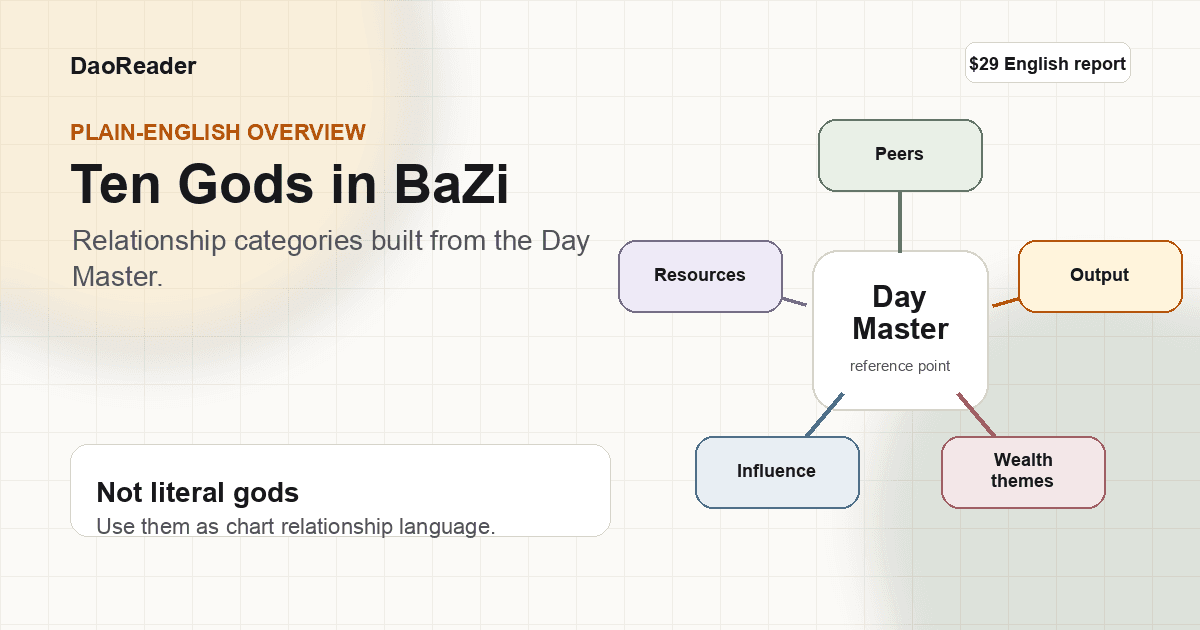
In BaZi, wealth-related language can describe how value, effort, control, opportunity, and responsibility are symbolically organized around the Day Master. A modern report should translate that into habits and prompts, not promises of income.
In BaZi, the wealth element is usually explained through the Five Elements relationship to the Day Master. It is not a stand-alone lucky token. A responsible report should explain whether wealth language is visible, hidden, supported, pressured, or missing in context, then translate that into reflection about value, effort, boundaries, and resource management.
Money is high-stakes and affected by real-world context: income, debt, law, tax, market risk, family obligations, health, location, and timing. DaoReader keeps financial decisions outside the reading and uses wealth themes only as self-reflection.
A safer wealth section asks questions such as: What resource am I protecting? What resource am I neglecting? Where does control reduce risk, and where does it block renewal? What real-world data or qualified advice do I need before deciding?
Searchers often arrive through phrases like BaZi money luck, wealth element, or finance reading. DaoReader deliberately translates those searches into resource-pattern reflection rather than promises about income, trading, debt, gambling, tax, business, or market timing.
A wealth section can be useful when it names habits around control, effort, preservation, support, and risk tolerance. It becomes unsafe when it recommends a financial action. Use the report to ask better questions, then use real data and qualified professionals for real decisions.
If you came here through a BaZi wealth reading or BaZi money analysis search, start with the calculator so the report uses your own birth date, birth time, birthplace, and time-known setting. Then compare the sample report to confirm the $29 product explains chart evidence, wealth element language, and financial-advice boundaries before checkout.
Before paying for a wealth-intent reading, check whether the page clearly rejects investment advice, shows a sample report, explains the one-time price, and links money language back to the full chart rather than one lucky symbol.
Example excerpt
This is not a personalized reading. It shows the level of specificity and caution a DaoReader report aims for: concrete enough to be useful, careful enough to avoid deterministic claims.
Example wealth reflection excerpt
Illustrative sample only. DaoReader does not provide investment, debt, tax, gambling, or financial planning advice.
The wealth theme in this chart is best read as a question about responsibility and control. The reader may be good at preserving resources, but under pressure that same strength can become reluctance to ask for support or reluctance to invest time in renewal. The useful reflection is not what to buy or sell; it is which resource is being protected and which one is being neglected.
Learn guides
These Learn pages explain the search intent behind this reading path, then point back to the calculator and sample report.
Boundaries
These boundaries keep the page aligned with the product: chart-based reflection, visible limits, and no professional-advice claims.
| Question | DaoReader answer | Boundary |
|---|---|---|
| Wealth element | Explained as chart relationship | Not a guarantee of income |
| Money luck | Handled as symbolic timing language | No promise of profit |
| Risk | Prompts for self-awareness | No trading or investment advice |
| Real decisions | Use qualified professionals | No substitute for planning |
FAQ
DaoReader does not claim that BaZi can predict wealth. Wealth language is used as reflective pattern language, not as a promise of income, profit, debt relief, business success, or financial outcomes.
No. DaoReader does not provide investment, tax, debt, insurance, gambling, trading, or financial planning advice.
A wealth element is a Five Elements relationship to the Day Master. It can describe themes around value, effort, control, opportunity, and responsibility, but it is not a guarantee of money or success.
It can support reflection on effort, control, value, support, and resource habits, as long as real financial decisions are handled separately.
DaoReader does not promise money luck. Timing language can be used as symbolic reflection, not a forecast of profit, income, debt relief, or market outcomes.
No. Business, investment, tax, legal, and financial decisions should use qualified advice, real data, and practical planning, not a BaZi report.
Yes. Use the calculator first so the report is tied to your actual Four Pillars chart, then inspect the sample report before continuing to checkout.
Enter birth details, review the Four Pillars context, then decide whether the report is useful.
Related reading paths
These pages target adjacent buyer questions while keeping the same responsible product boundary.
Start with birth details, review the chart context, and continue only when it feels right.